hardly hand knitted patterns of yourself onto an easy chair, right sided stitched the left heart lifted up from the other chair, mind between headed upper and bellied inwards, making a fist while trying to hold on to water running over the worlds one never tries to cross
coming up
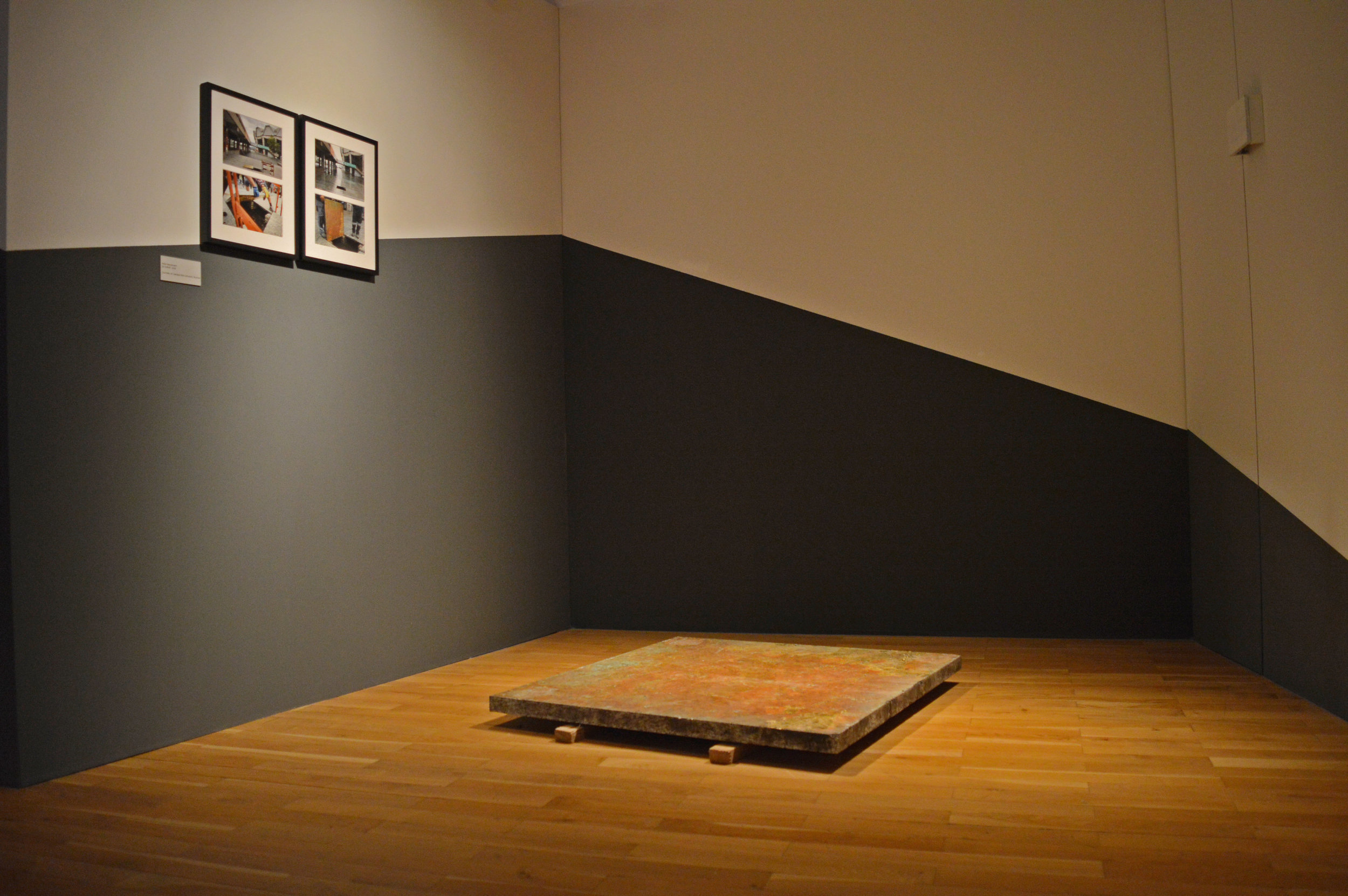
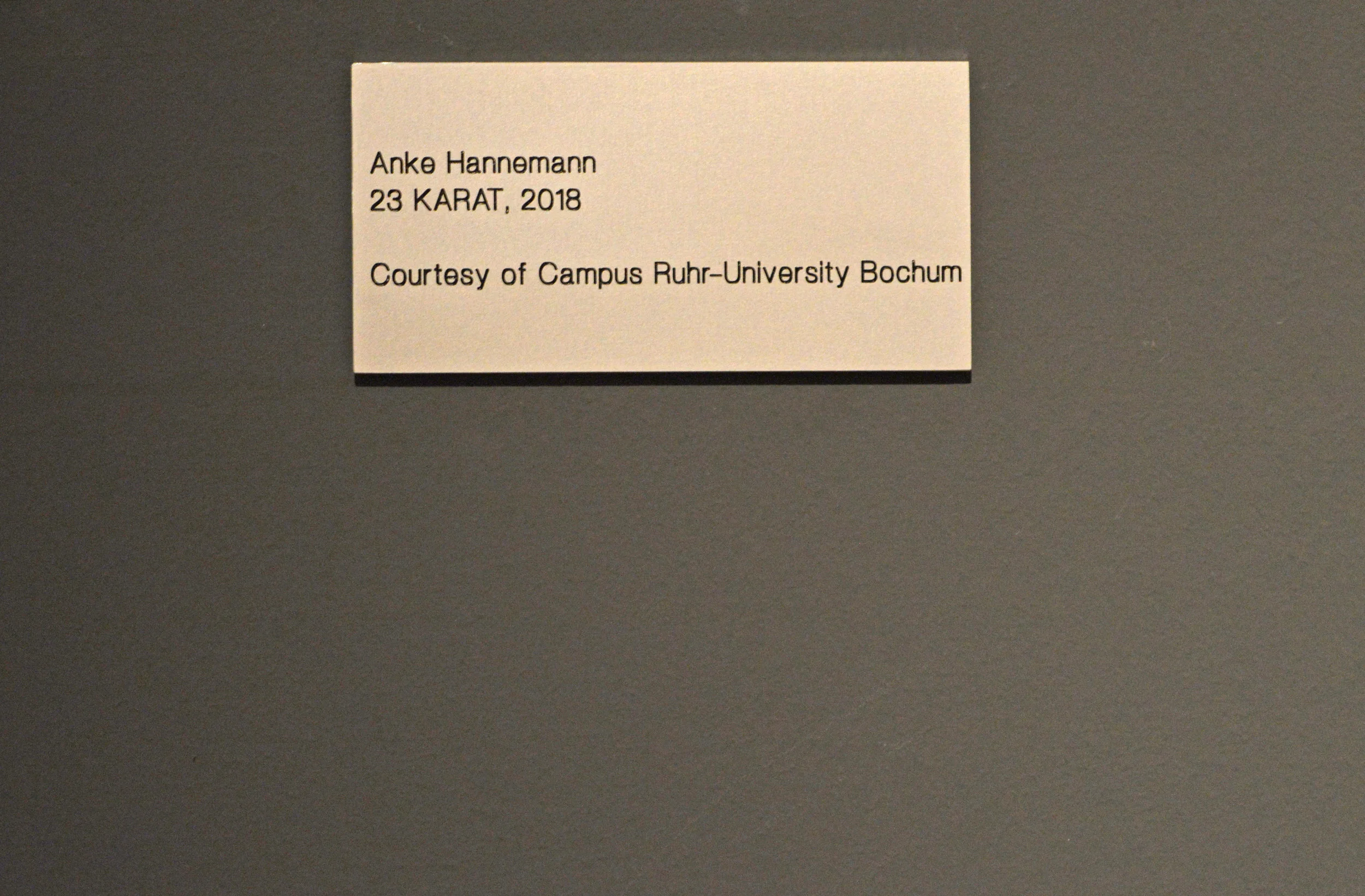
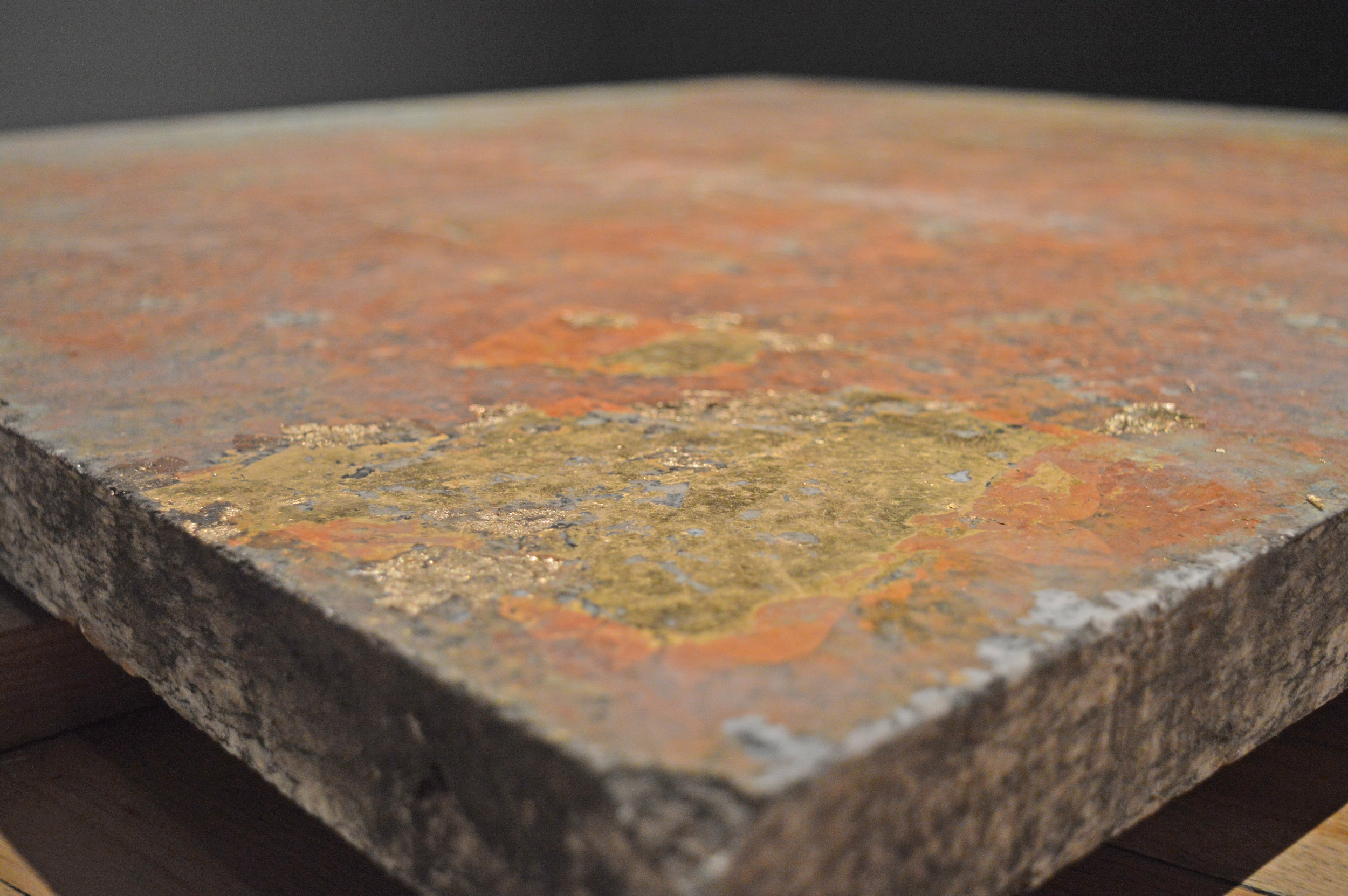
23 KARAT, 2019
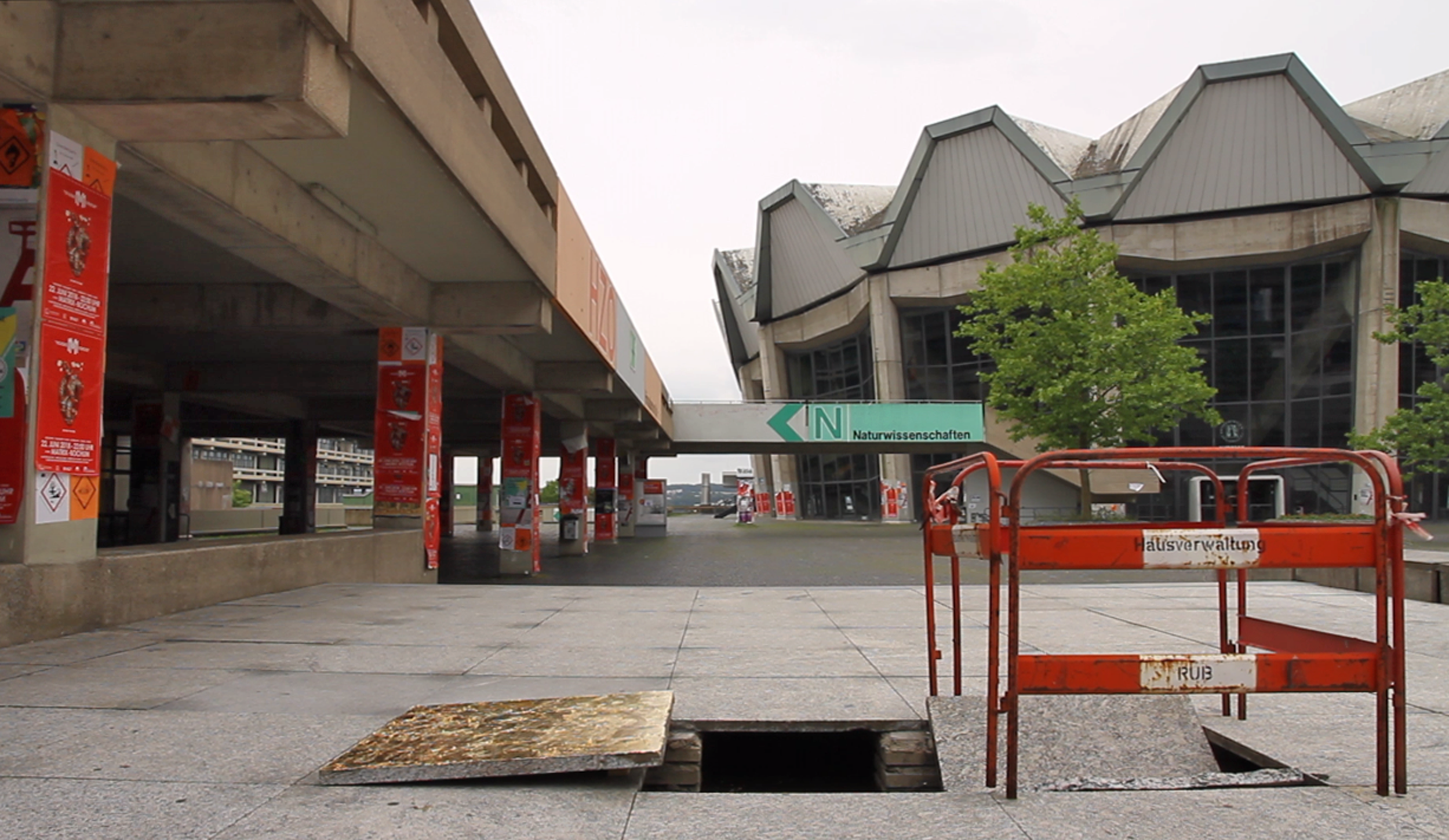
floor plate gilded with 23 Karat gold leaf, engraved sign/label, 4 photo prints
intervention | installation Schiller-Museum Weimar
Courtesy of Ruhr-University Bochum
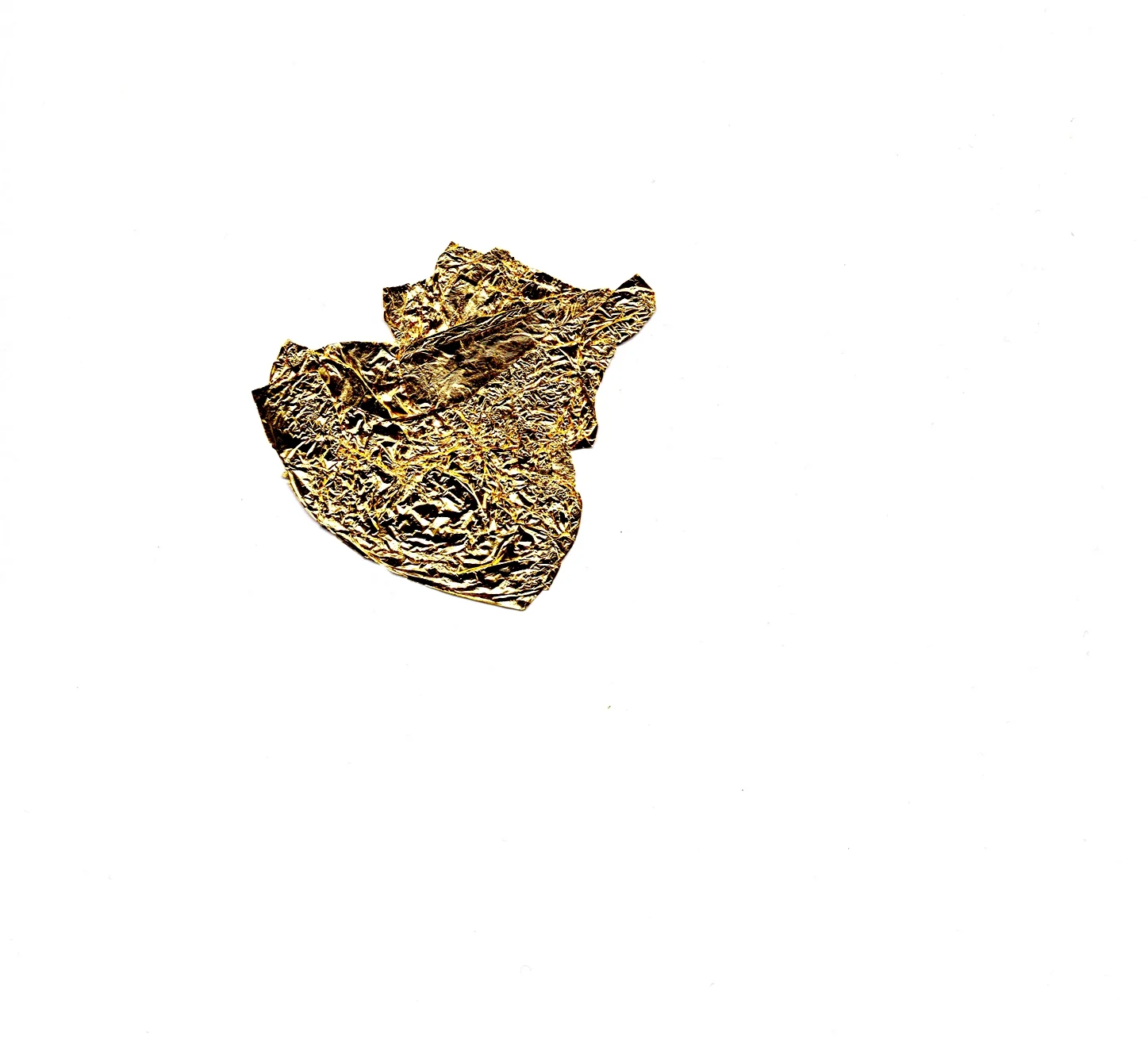
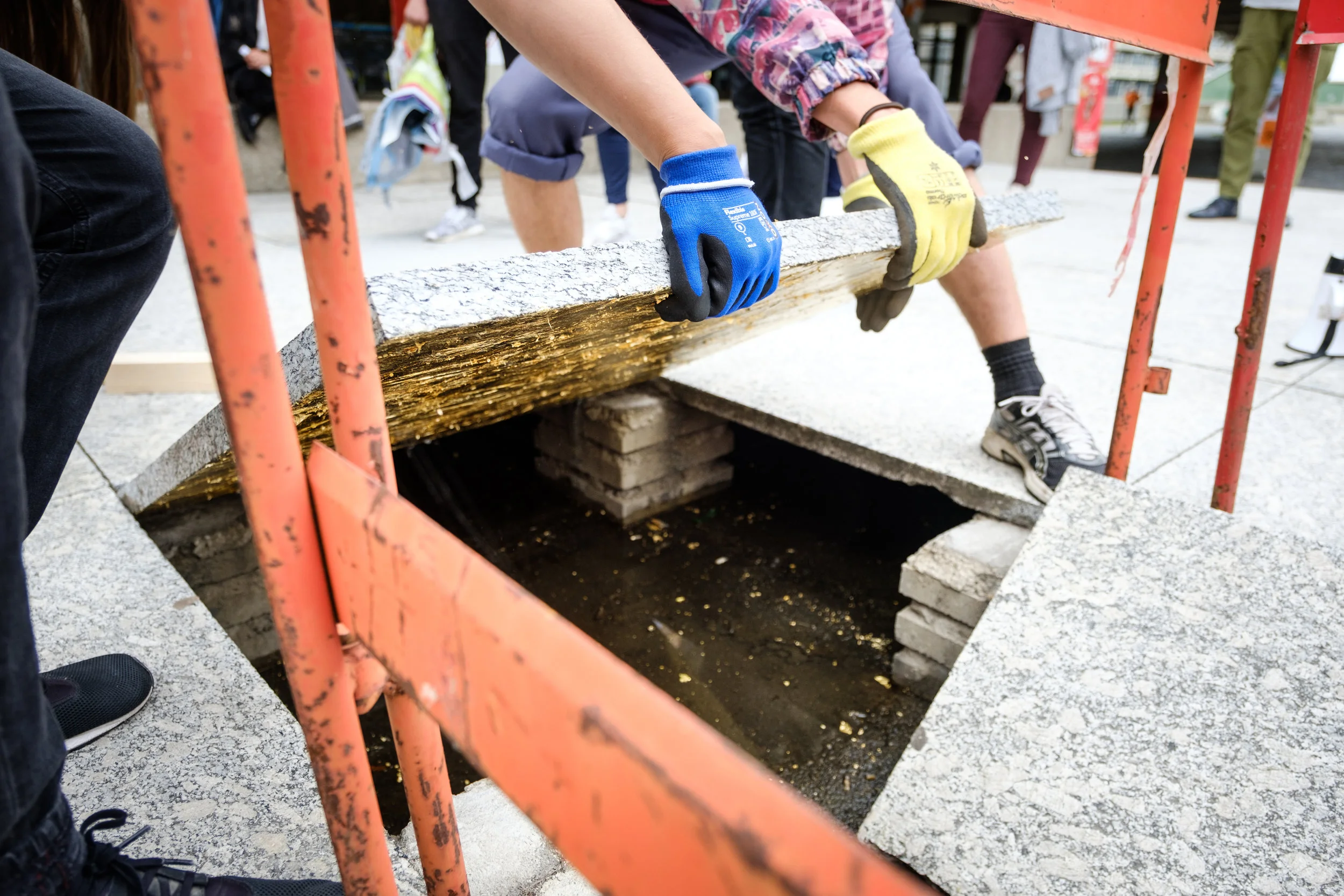
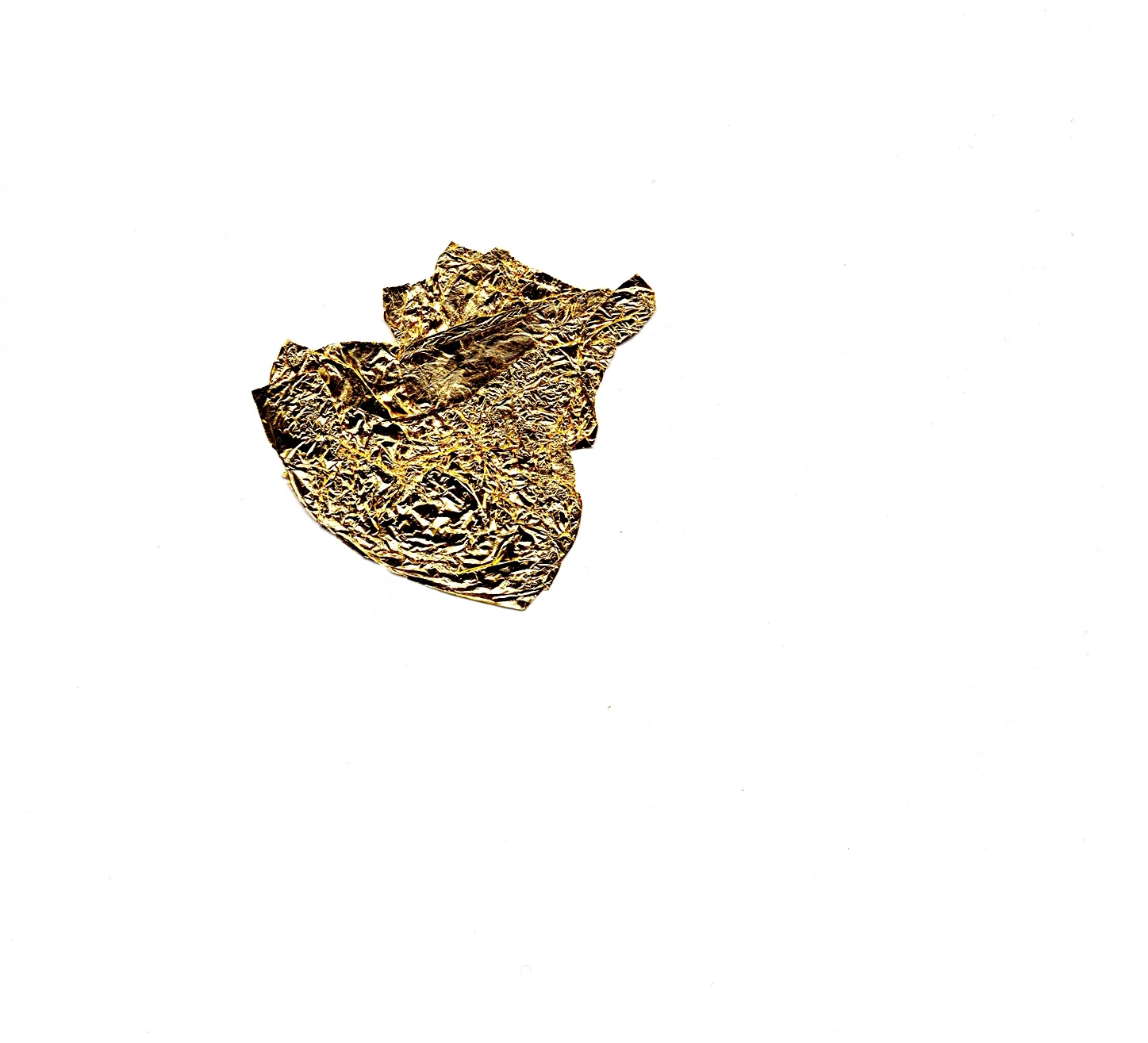
Displaying a gilded concrete floor plate from the campus of Ruhr-University Bochum inside the spaces of Schiller-Museum, the artist draws attention to the discourses around the preservation of Brutalist architecture. Currently in a state between decay, deconstruction and restoration, the university was the first to be constructed in Western Germany after WWII and served as a key example of the new way of building. While some of its architectural elements have been listed since 2015, the original floor plates are set to be replaced. As a response and in order to pay homage to the often overlooked workers engaged in reconstructing, renovating and demolishing such architectures, the artist gilded one of the plates on the reverse. In a second installment of the work, the plate is now on loan at Schiller Museum, turned from a functioning object into exhibition loan. Displayed with regular exhibition labels, the artist elevates this pedestrian architectural element to an object of modernist material culture worthy of preservation by the museum institution while the gold on the floor plate has almost vanished over time.
Realized within the framework of IMAGINARY BAUHAUS MUSEUM | MFA »Public Art and New Artistic Strategies«, Bauhaus-Universität Weimar
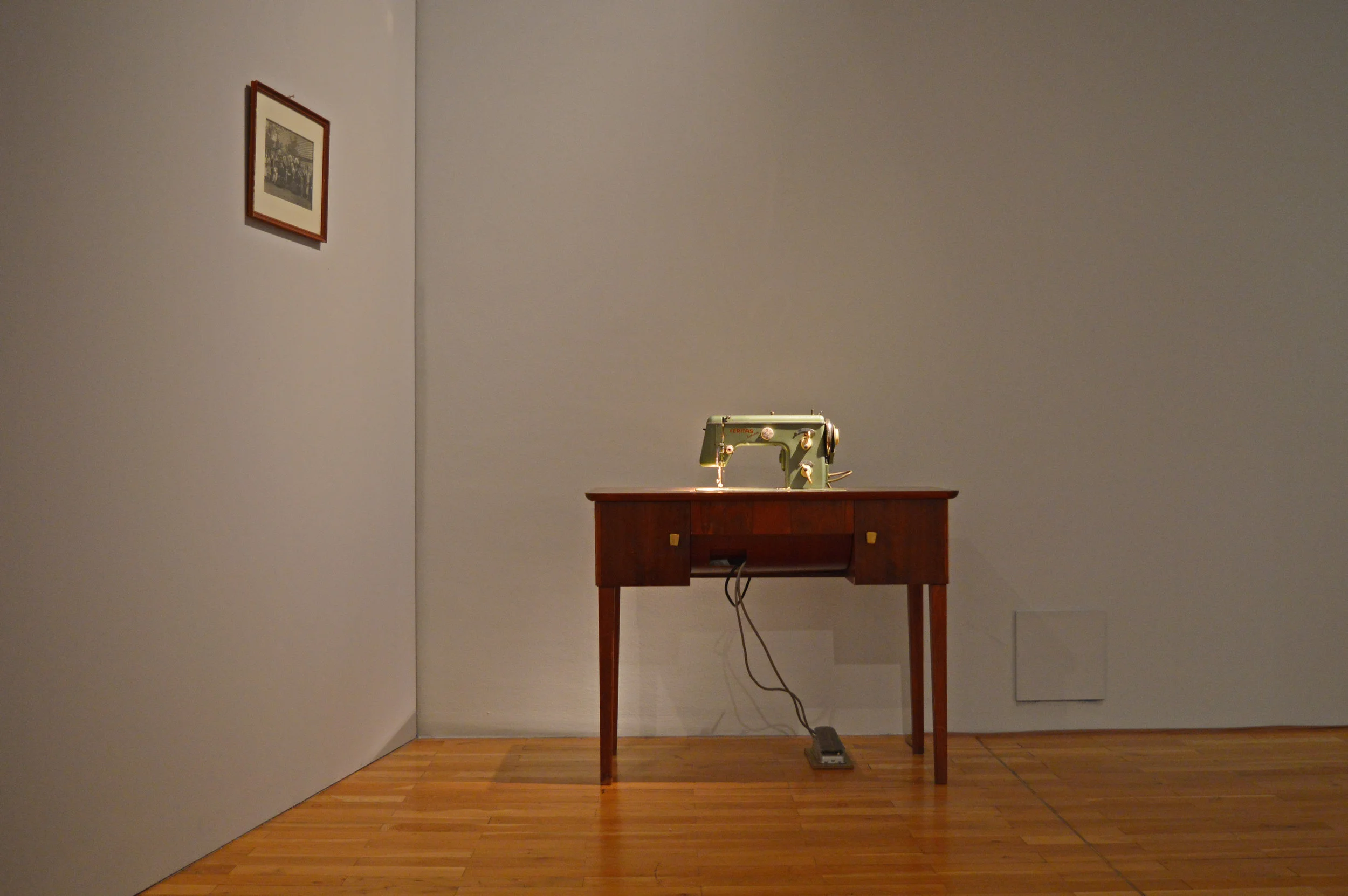
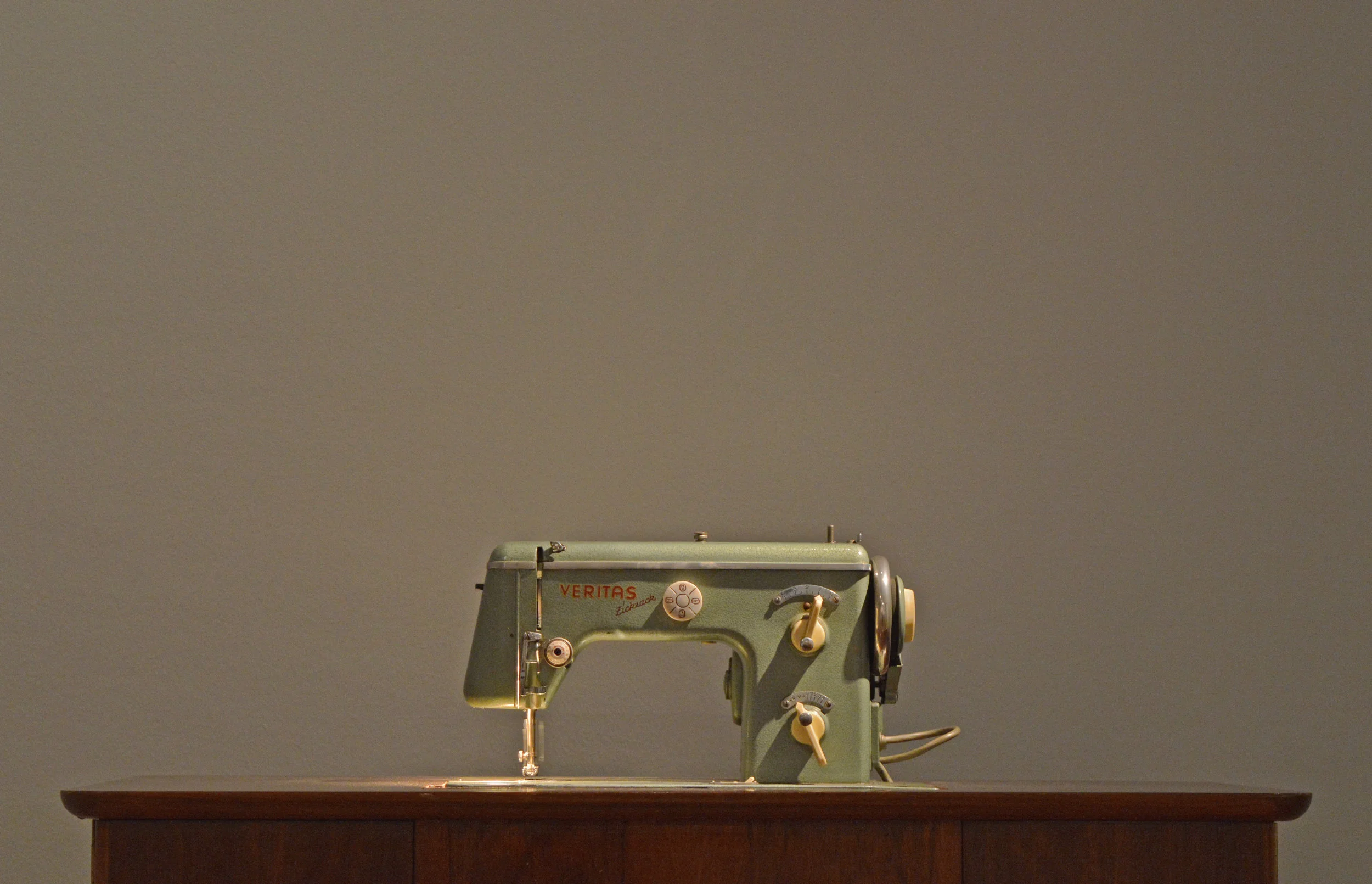
VERITAS, 2019
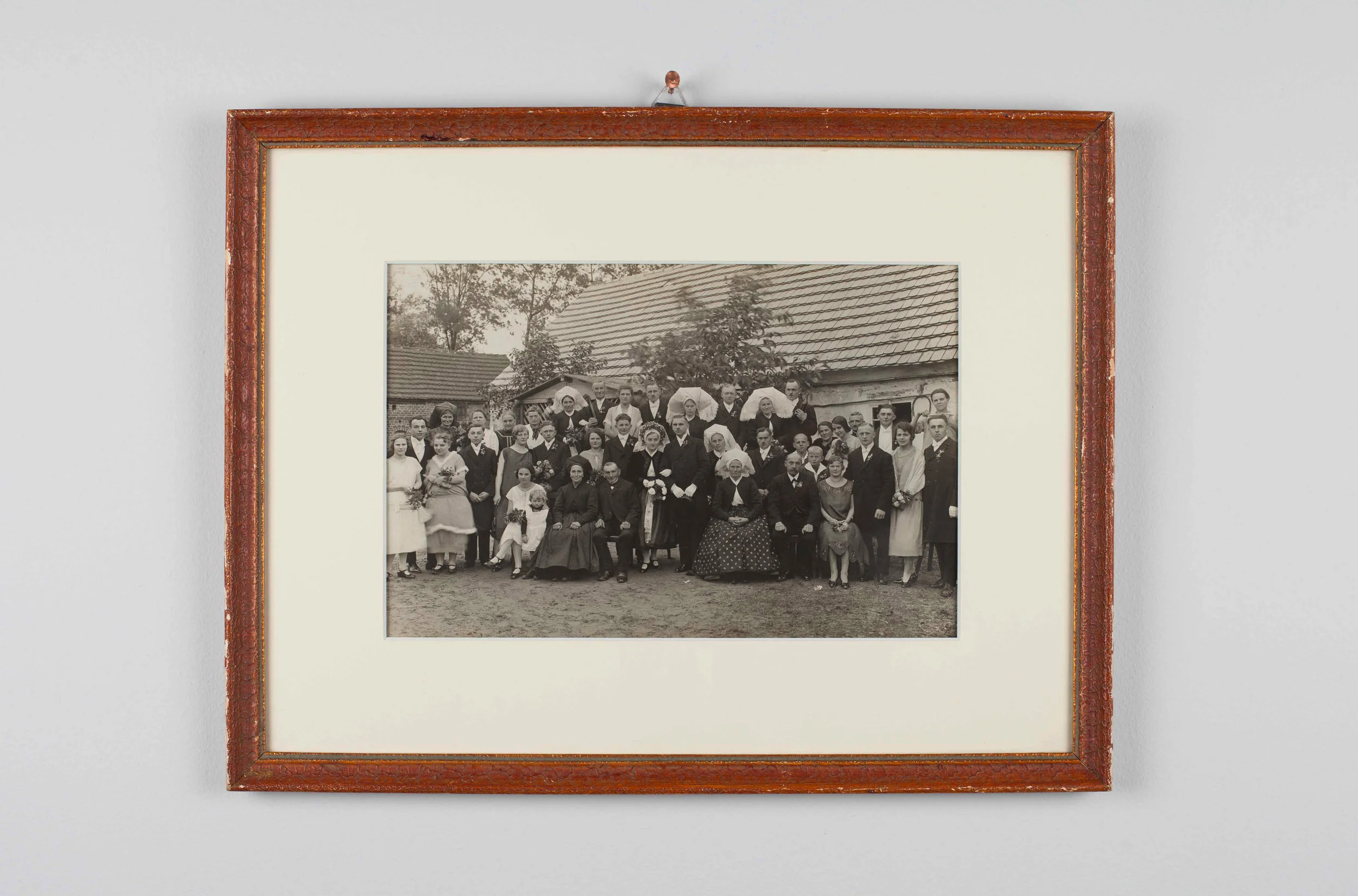
modified sewing machine set in reverse mode, gilded needle, framed wedding photograph of the artists’ great-grand parents
installation | Schiller-Museum Weimar
The people and landscapes of the Lutsatia region have been marked by the mining industry which was the most important employer during the GDR area and beyond. The exploitation of resources went hand in hand with the forced relocation of entire villages primarily inhabited by members of the Sorbian minority. Pieces of Sorbian identity and culture disappeared together with over 130 villages over the last 100 years. The artist presents a manipulated VERITAS sewing machine from the formerly state-owned Kombinat VEB Nähmaschinen-werk Wittenberge that automatically saws backwards together with a wedding photograph of her own great-grand parents. The work draws attention to the at times complicated relationship between dress and identity. In the artist’s own family history, traditional Sorbian garments have acted as a tool through which this identity was respectively undressed, thrown away and produced in doll size to make a living over the course of several generations. Switched on without producing anything, the sewing machine points to the cultural void left behind.
Technical support: Peter Schwieger
Realized within the framework of IMAGINARY BAUHAUS MUSEUM | MFA »Public Art and New Artistic Strategies«, Bauhaus-Universität Weimar
23 KARAT
Public Intervention
bottom part of floor plate gilded with 23 carat gold leaf
Ruhr-University Bochum
2018
Realized within the framework of CHE BELLA BRUTTA! - BAUHAUS GOES BOCHUM | MFA»Public Art and New Artistic Strategies«, Bauhaus-Universität Weimar in collaboration with RUB arts & culture international, Ruhr-University Bochum.
MY GRANDFATHERS DAILY ROUTINE SINCE APRIL 1945
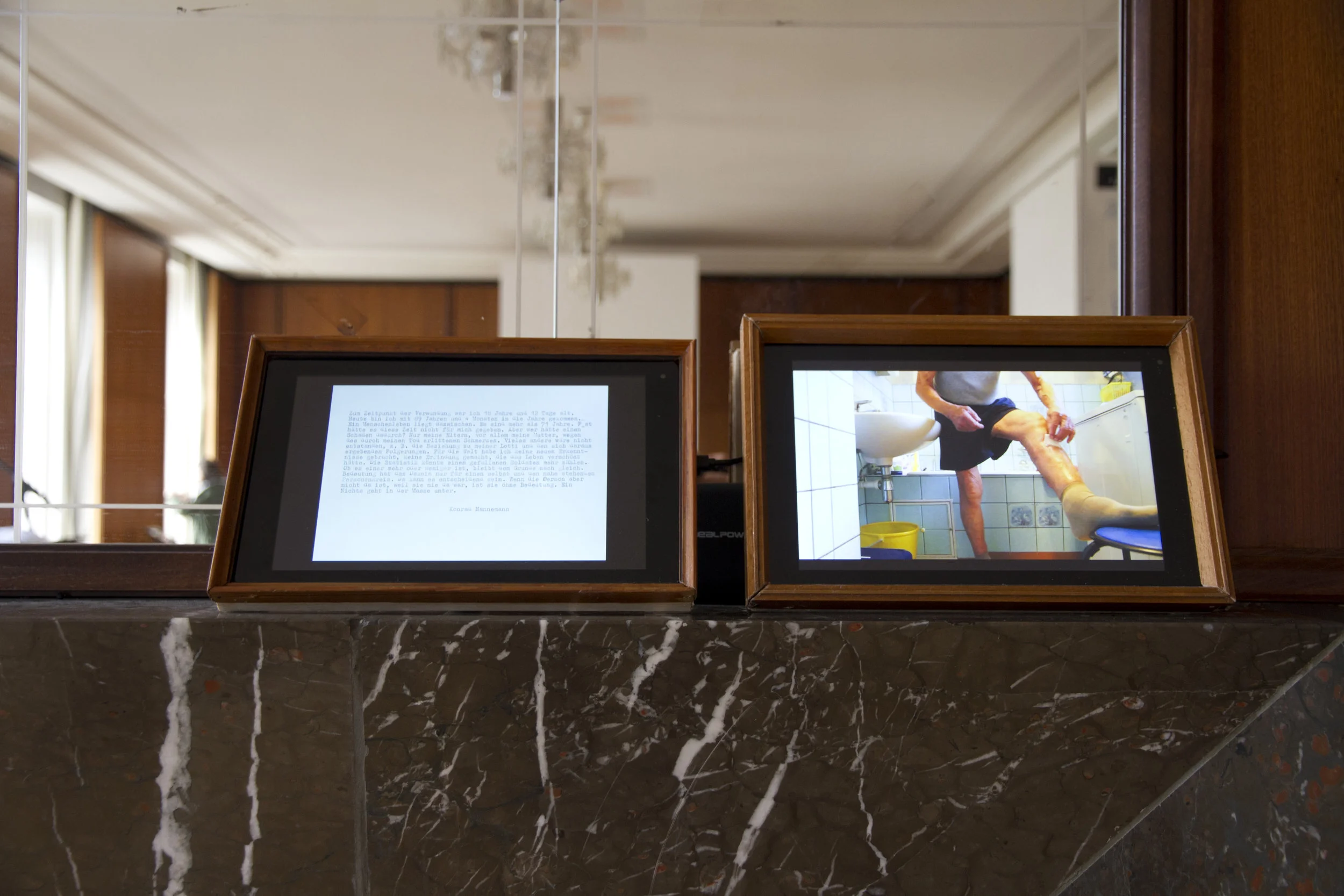
2-Channel Video Installation
Kronprinzenpalais, Berlin
2017
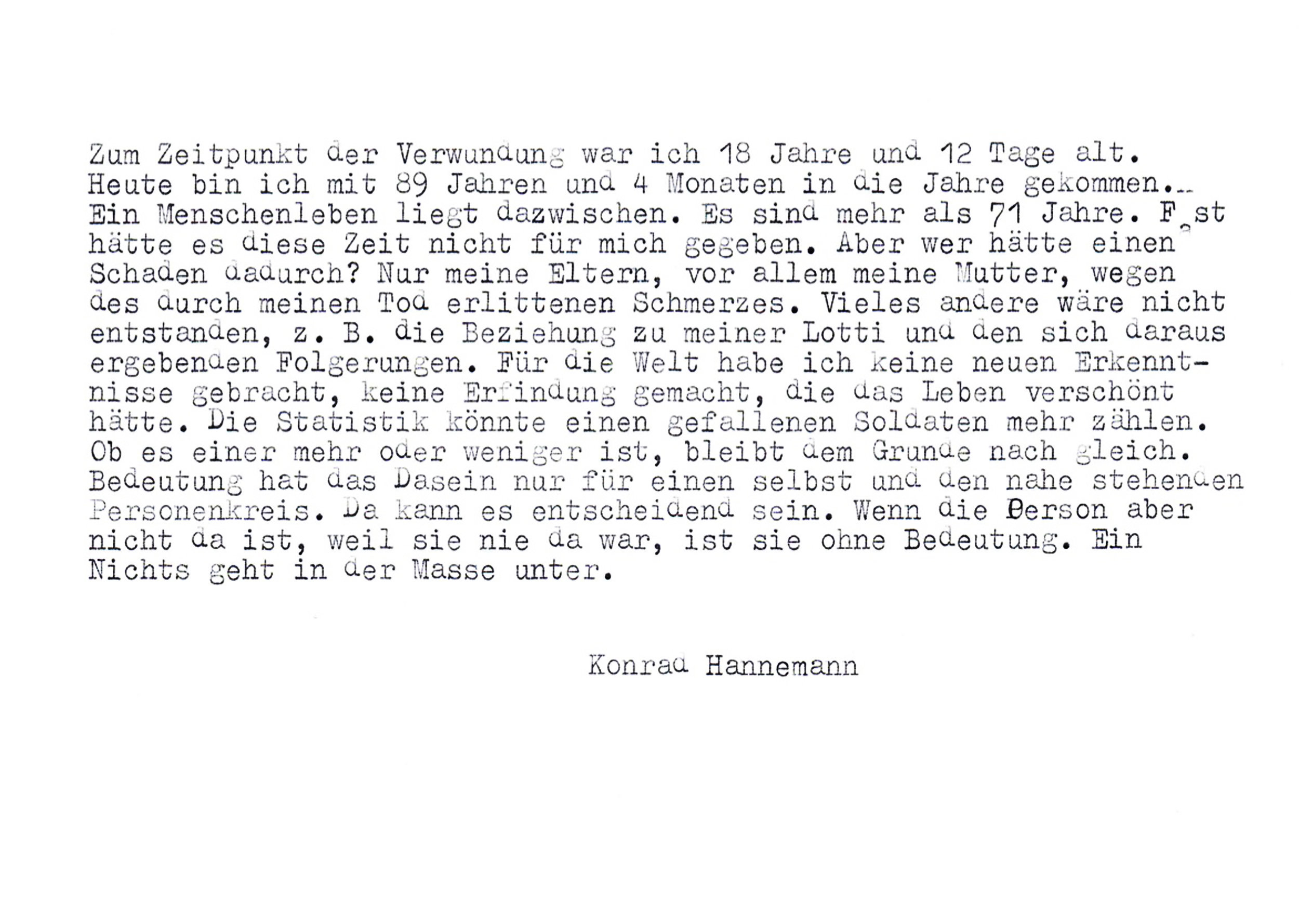
For the last 72 years, the artist’s grandfather has been taking care of his wounded leg in a daily routine. Being a soldier during WWII, he was shot in april 1945 when capitulating, just weeks before the war ended. The wound closes and opens and is not able to heal ever since. In his diary note he states: “I did not bring any new knowledge to this world nor did I make an invention that would have embellished life.”
Realized within the framework of DISINTEGRATION, 3. Berliner Herbstsalon, a collaboration between the MFA »Public Art and New Artistic Strategies«, Bauhaus-Universität Weimar and Maxim Gorki Theater Berlin
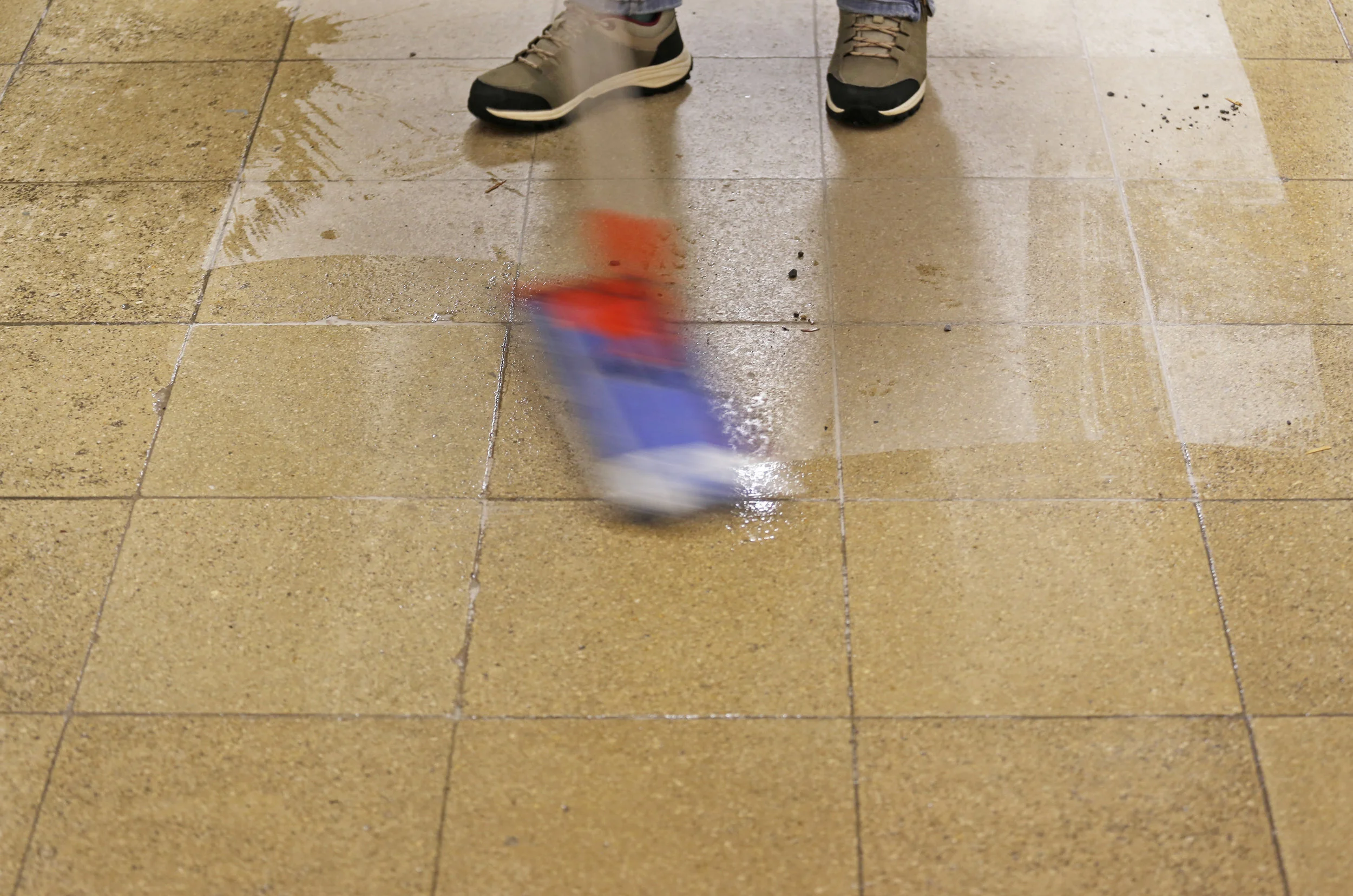
DANCE LIKE THERE IS NO TOMORROW – A CHOREOGRAPHY BASED ON THE CLEANING STAFF ROUTINE OF BUCHENWALD MEMORIAL
Installation
Buchenwald Memorial / Momentum Gallery Berlin
2016
ZUHEIM – HOME REWIND
research and public intervention
2008 – on going
If there is no immanent memory inherent in places, they are nevertheless of first-rate significance for the construction of cultural spaces of recollection.
Aleida Assmann, 2006
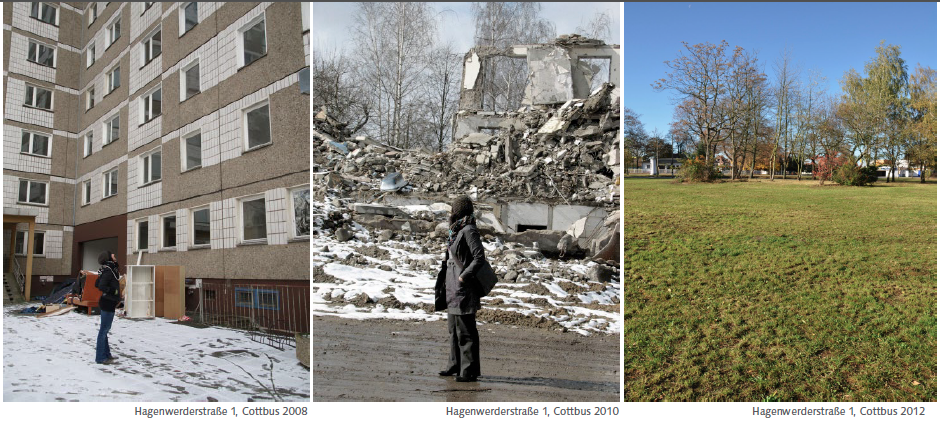
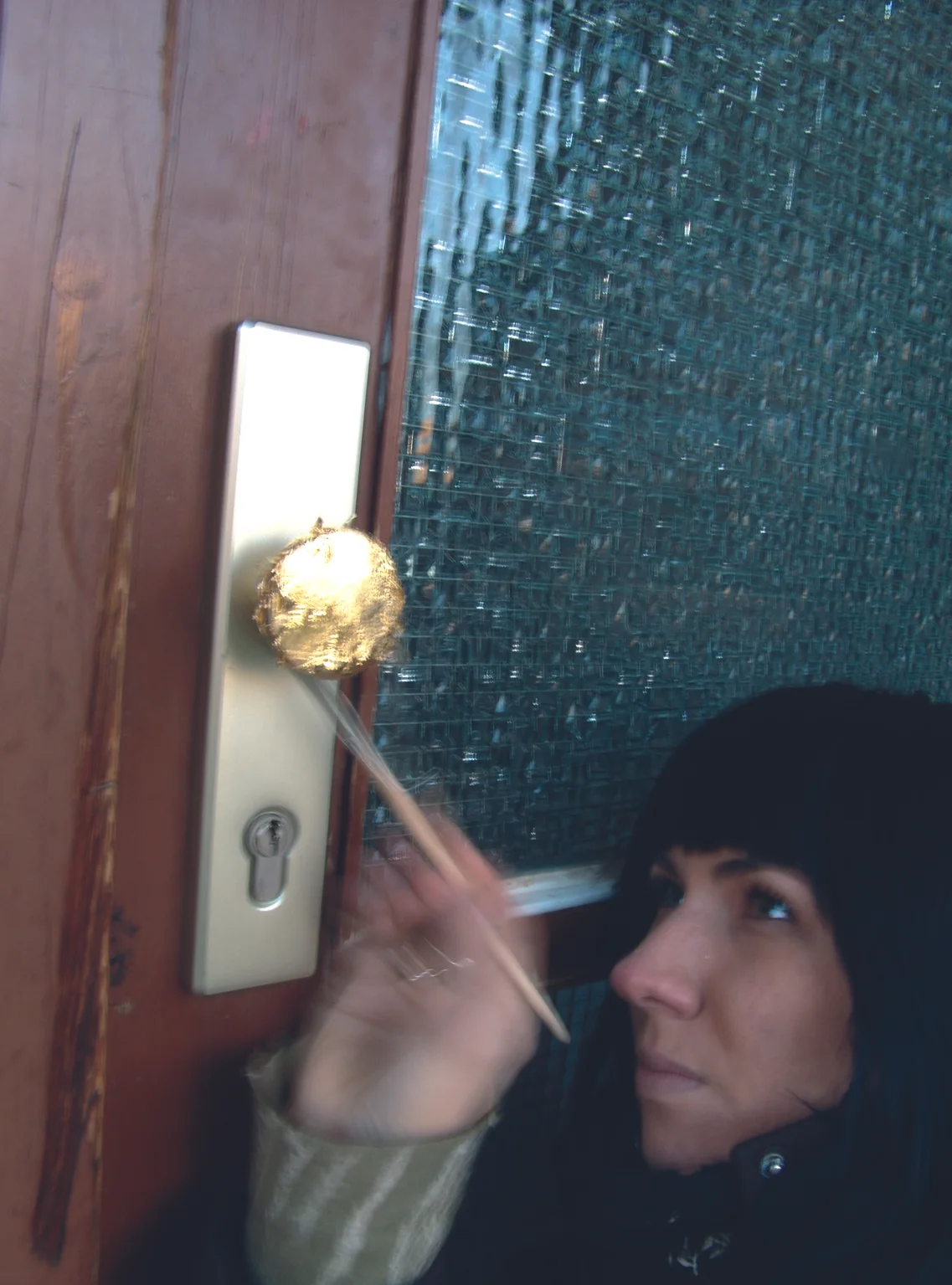
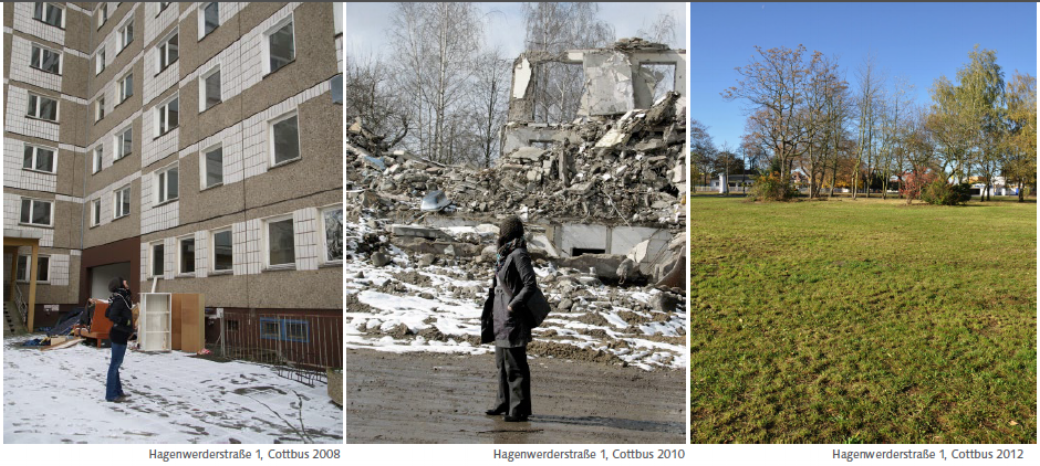
From the personal to the broader context, our built environment is central for the formation of memories, learnt knowledge and further, identity. After the fall of the Berlin Wall and within the last 24 years, east german cities, such as Cottbus, Halle, Leipzig or (East) Berlin have found themselves being deconstructed and transformed entirely, especially along their peripheries. The massive collection and huge neighbourhoods of typical socialist high rised buildings (so-called Plattenbauten) that, during the GDR were homes to hundreds of workers families soonly stood empty and abandoned, due to the vast migration to the “west” and newly gained possibilitessomewhere else.
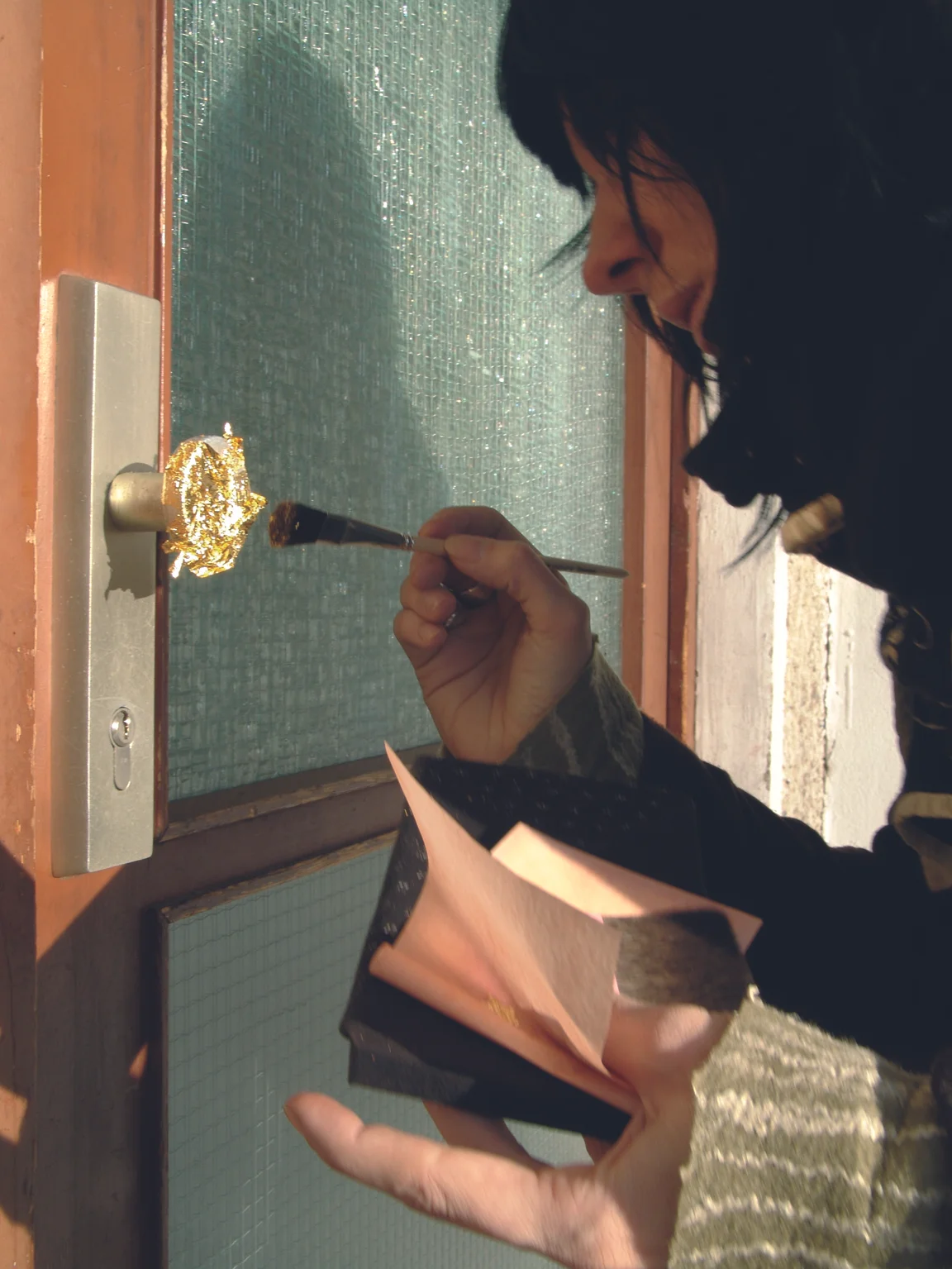
Growing up in Cottbus, in a Plattenbau myself and leaving the city with my family four years after the reunification, I have lost track of the urban and architechtural transformation of my home town during the past decades. For the work ZuHeim - home rewind, in 2008 I went back to rent out and live in the exact same apartment I grew up in for one month. Despite the fact, that the neighbourhood I once knew had changed dramatically, being plagued by ghettoization, I was not able to find myself around anymore. Buildings have been torn down, homes of friends, Kindergarten and my school did not exist anymore. All that I found were plane fields of gras.
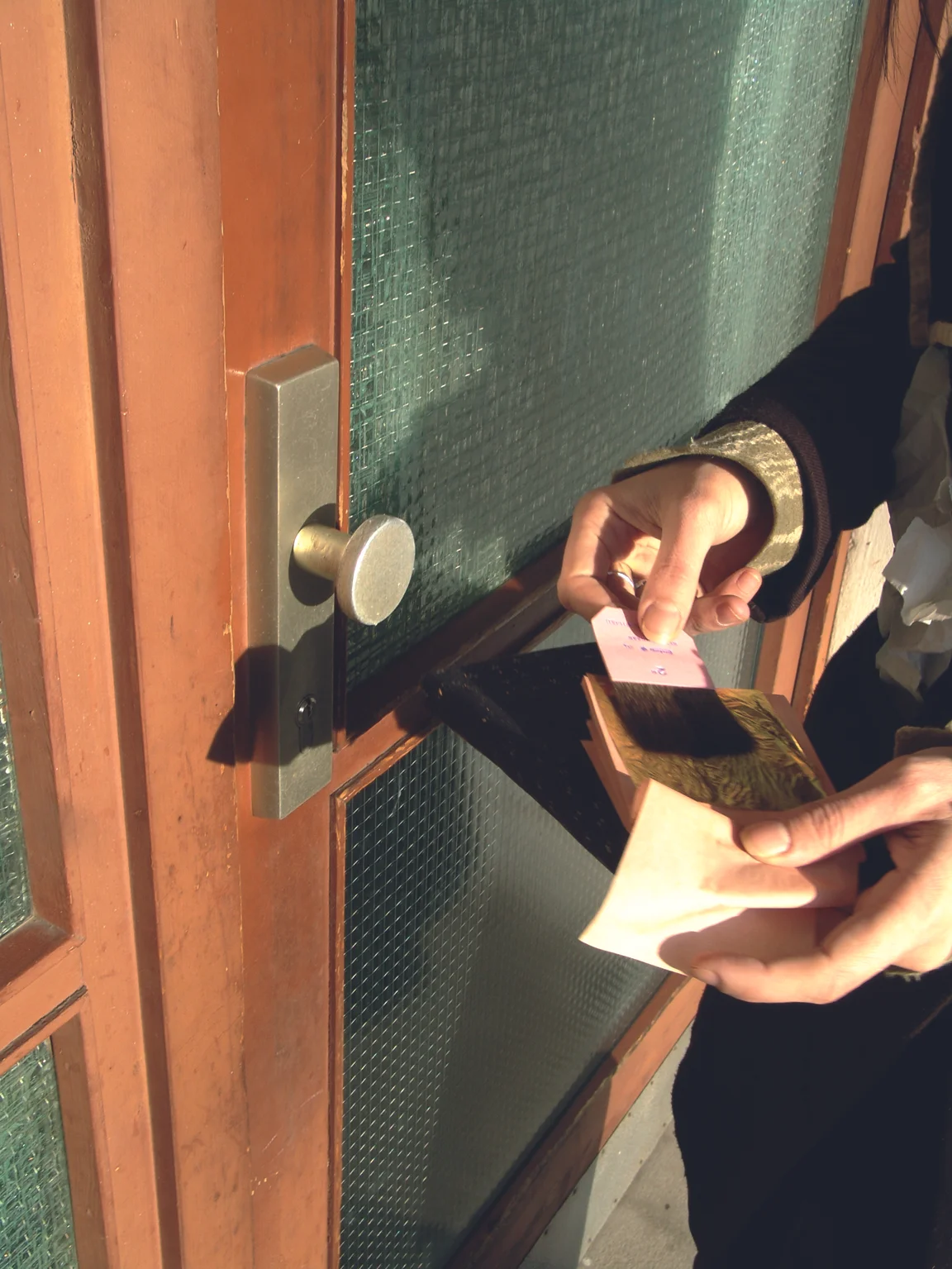
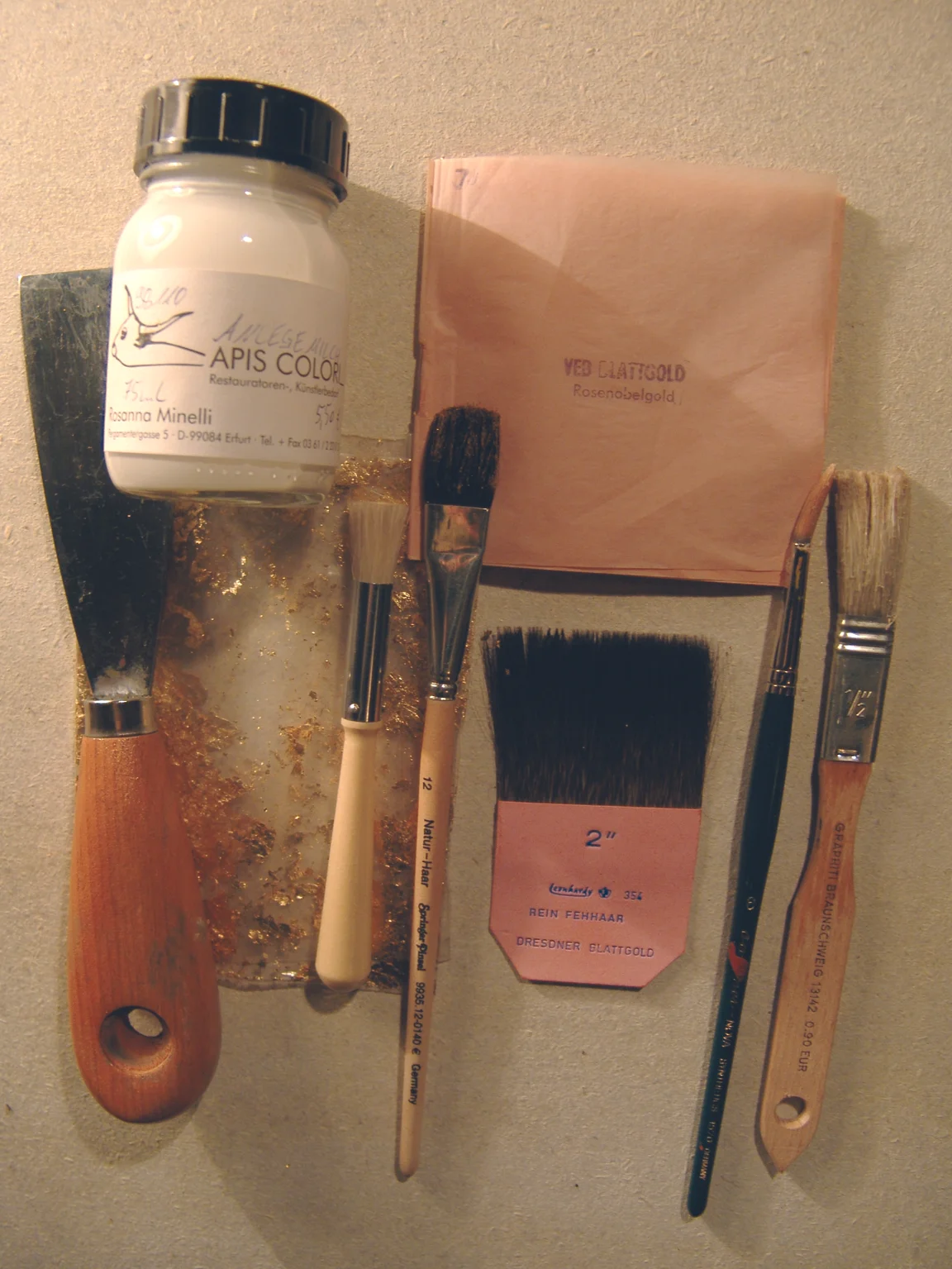
Proceeding with the gilding of 24 door knobs of the buildings that would be torn down within the upcoming two years and including my very own former home, the Plattenbau I grew up in, following questions arose:Do we need concrete places or buildings to be certain of our memory? Does the deconstruction of a particular place, the deconstruction of a lived past ask for a reconstruction of ones own memory, identity?
JUST DON’T KNOW WHAT TO DO WITH MYSELF
Collaboration with Nima Keshtkar and Ina Weise
live sound performance and
video documentation
Mostar, BiH
Over two decades after the Bosnian War, Bosnia and Herzegovina (BiH) is still plagued by a weak economy, political corruption and divided communities. Mostar, situated in the southern region of Herzegovina, is one of BiH’s most culturally diverse cities, where Bosniaks (Muslims) and Croats (Catholics) live in a city that has no physical border, but remains deeply divided not just politically but also mentally.
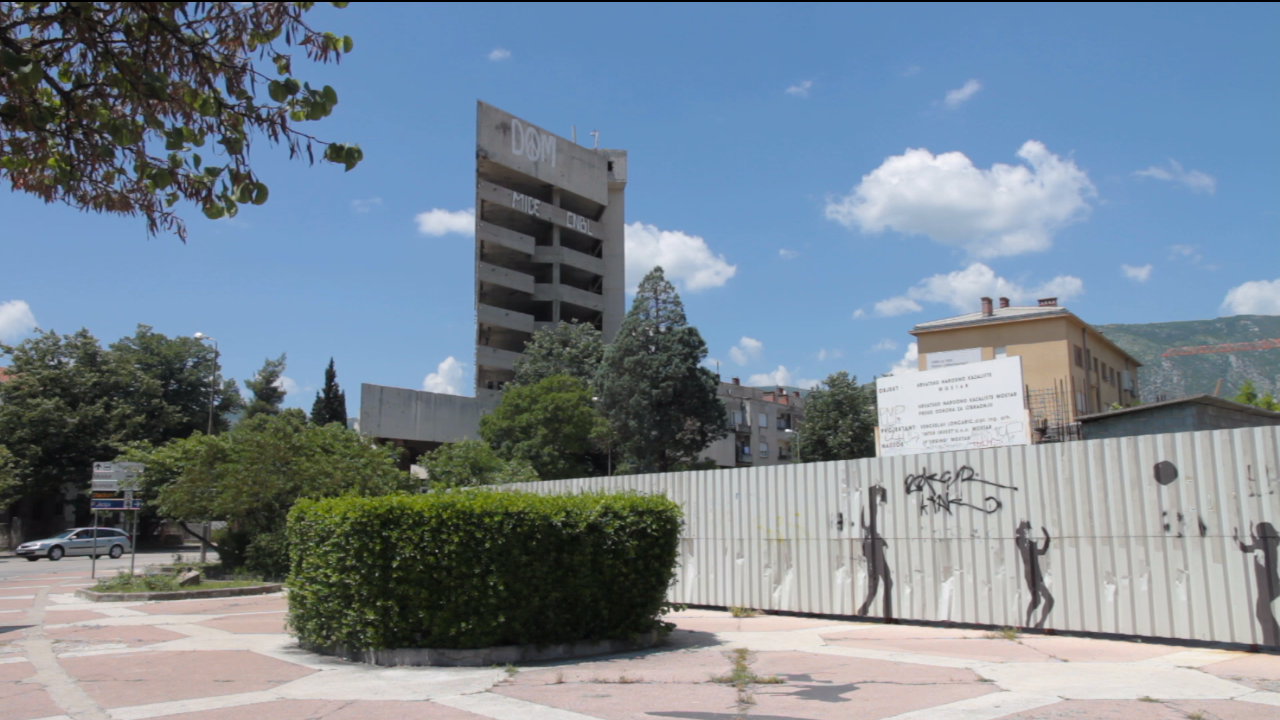
Like numerous buildings in the city, the so-called Glass Bank (“Staklena Banka”) in the center of Mostar was destroyed in the early 1990s during the Bosnian War and left to deteriorate ever since. The decaying skeletal concrete structure of the former bank marks the Spanish Square, a square once teeming with people commuting and communicating as part of every day life. Today the square offers an assortment of destroyed and abandoned buildings, inoperative fountains, perpetual construction sites, a small park, and a newly renovated school building. Like many sites in Mostar, the Spanish Square represents life in a constant state of inertia; an in-between state where no one knows what to do.
In the site-specific performance Just don't know what to do with myself, Anke Hannemann sings the line "I just don't know what to do with myself" (from a song originally recorded by Tommy Hunt) repeatedly from the inside of the Glass Bank. The sound of her voice is amplified through loud speakers, echoing throughout the city. The performance begins at 1 pm, after the tolling of bells from the Catholic Church and in-between the calling of the Azan. Hannemann’s voice reverberates across town for five minutes and stops just as abruptly as it started. The repetition of the phrase emphasizes the literal meaning of the line and adds another layer of ironic momentum that refers to the static situation in the city. Through the repetition of the one sentence, the performance becomes just as recognizable as the two main features of Mostar’s soundscape: the sound of the Catholic Church’s bell on one side of town and the Azan reverberating from the mosques on the other.
Instead of constructing a single linear or joint narrative the work tries to create and initiate a new one. The statement “I just don't know what to do with myself” highlights the difficult situation of many people living in a persistent state of stagnation, trying to overcome decaying urban, cultural and political structures, while dealing with religious, ethnic and territorial differences after a time of war.
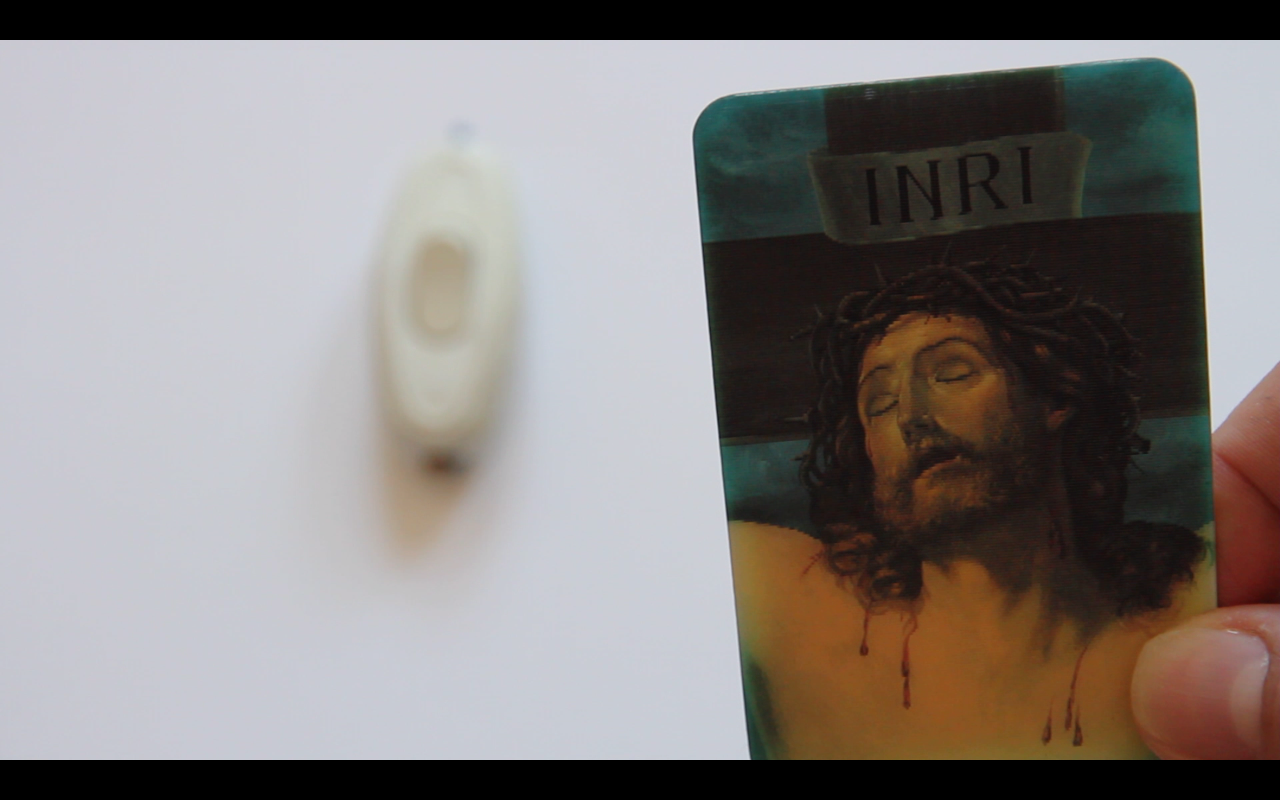
TURN ME ON, JESUS
found light switch, souvenir card
1-channel video projection / loop
2013
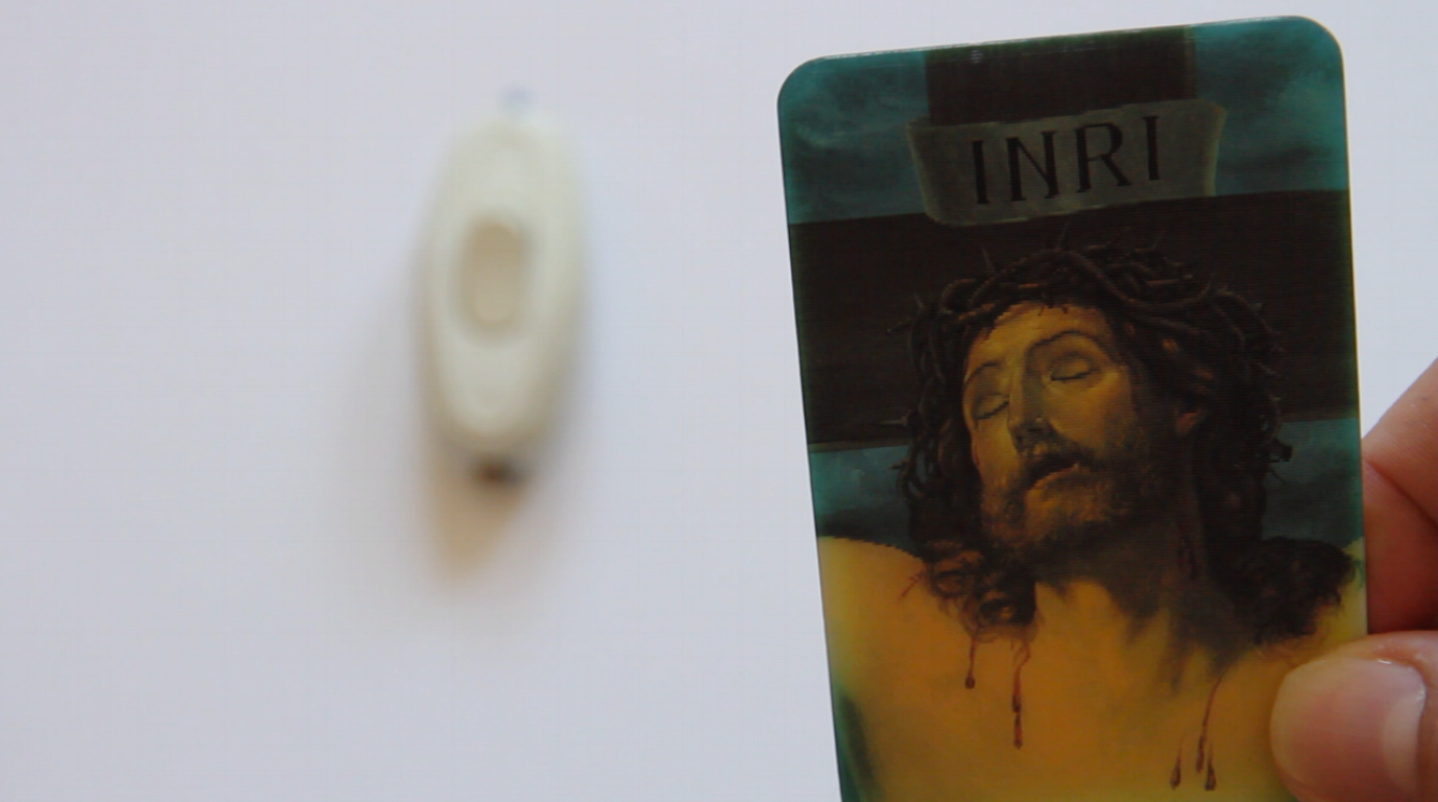
A found light switch and a souvenir card showing Jesus on cross: his eyes blink and are switched on and off for an infinite flirtation with the son of god.
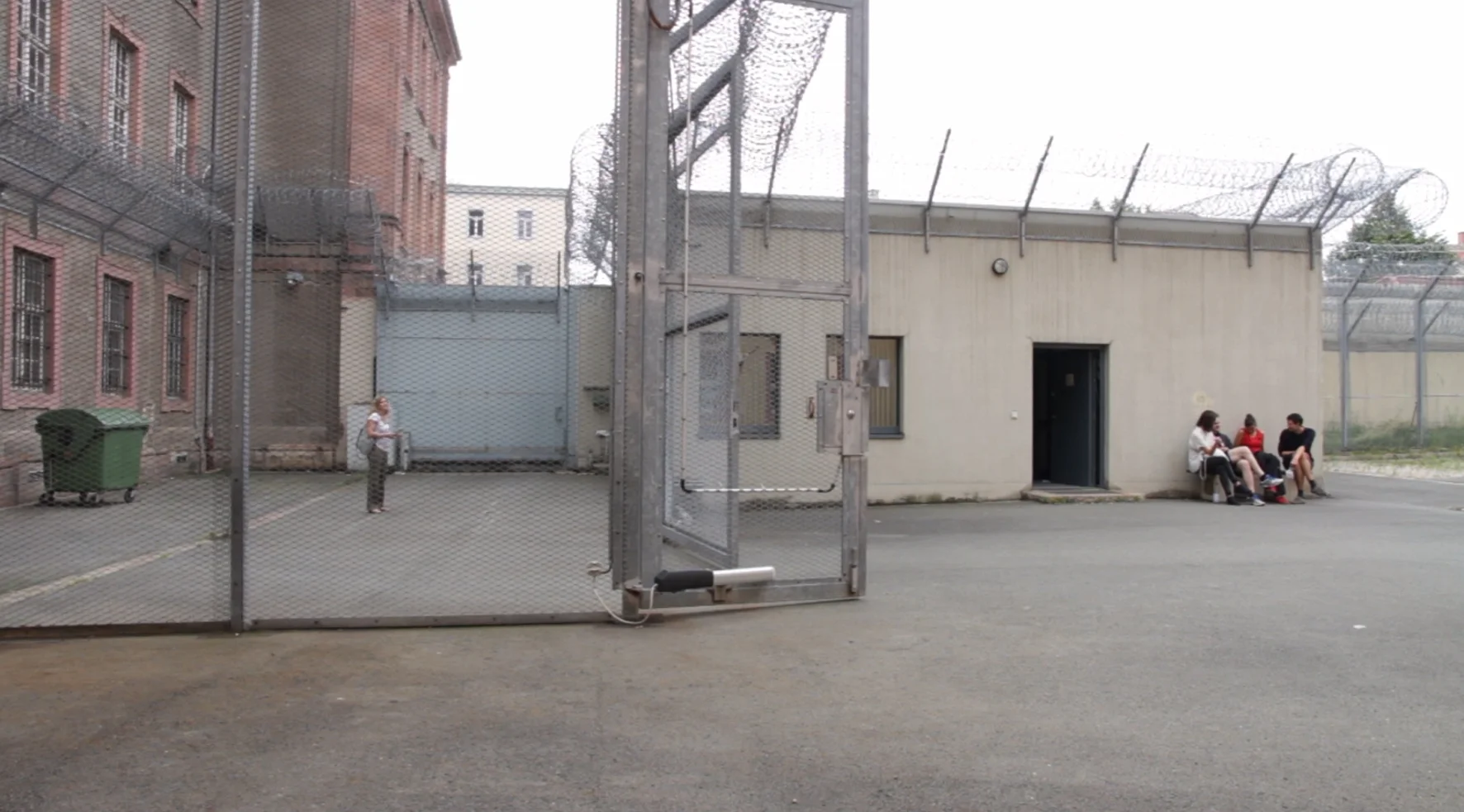
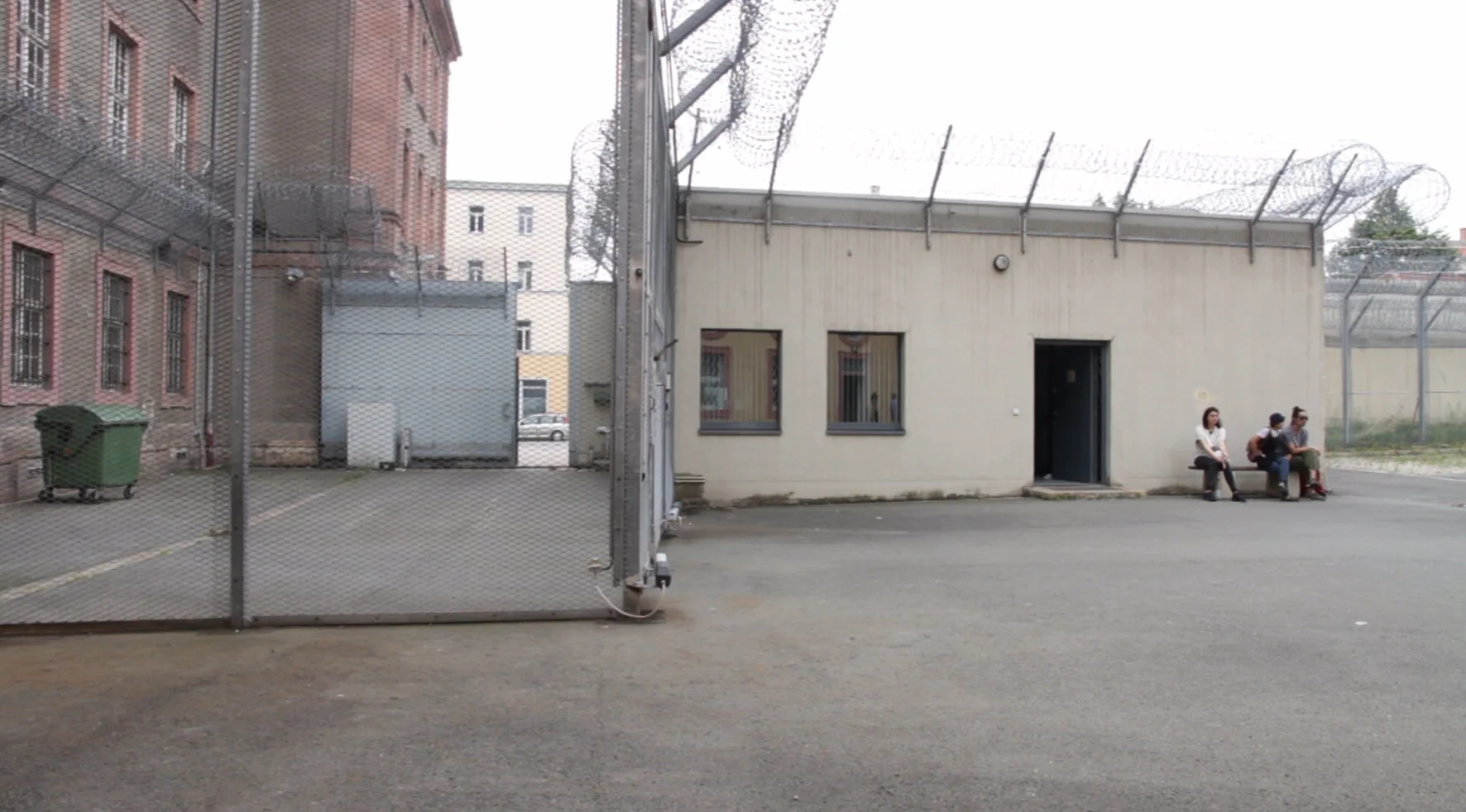
GATES
in collaboration with Vasili Macharadze
public intervention
fully automated set gates
former juvenile prison Weimar
2015
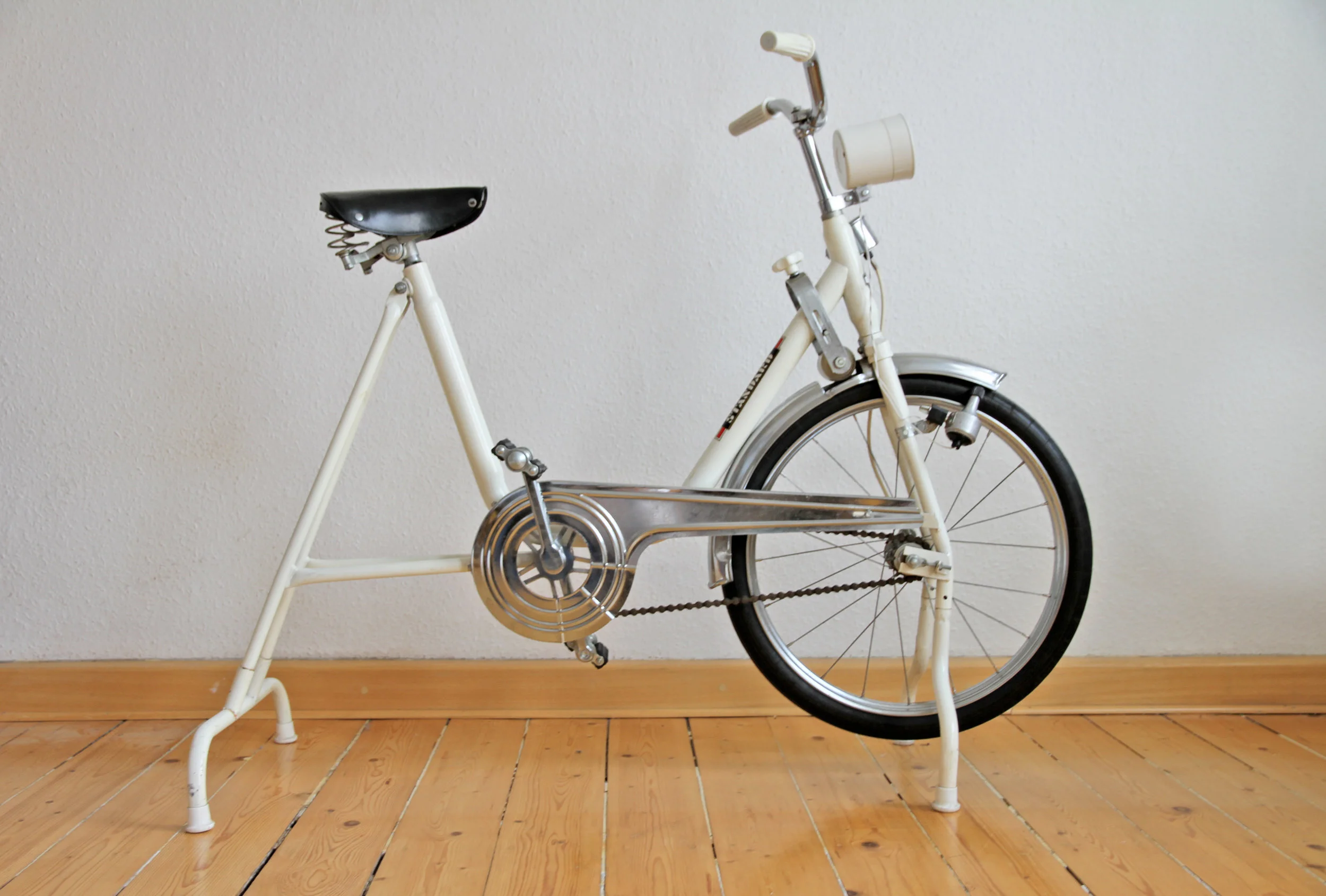
WIND OF CHANGE 2014
object, interactive Installation
old hometrainer, siren horn loud speaker, MP3 recording, found bicycle dynamo
2014
The work WIND OF CHANGE 2014 refers to the internationally known rock-pop song „Wind of Change“ by the german band The Scorpions, who reached international success with it in 1990, when the fall of the Berlin Wall preluded the end of the Cold War. The events of the time that marked the major political change in (Eastern-)Europe, occurring in the end of the 1980s are commemorated in the original song text, which in the media was described as “the athem of the Wende”.
The distinctive whistling melody from the song opening resounds once the home-trainer is used and pedaled and only plays out loud when the pedaling continues reaching a certain speed on the tachometer.
In times of omnipresent social and political protest movements that keep rising on the streets around the globe and in the face of present and ongoing worldwide crises that seem to split up Europe and the rest of the world, we cannot blind ourselves in regards of duties and responsibilities. We therefore not only have to pedal strongly for a change, but we have to be active on order to change something. Ironically the Wind-of-Change bicycle leaves you stuck in one position and no matter how hard you pedal, it does not take you anywhere.
MY NAME IS SABIL
1-channel video projection
Bangladesh
2013
Bangladesh is one of the most vulnerable countries for iterative cyclonic tropical storms that keep destroying the land, life and property of the local population, especially in the coastal regions. The region of Satkhira, in the south of the country is thereby one of the worst effected areas. The regularity of recurrent storms and floods, the political condition and the lack of basic funding from a corrupt and instable government hinder the processes for a potential development building more adaptable housing that would allow local people to live better with the disasters.
Despite these adversities, it is the people in that region who love their home, not willing to leave and de facto independently deal with the situation by trying to build houses on their own that can withstand the storms more or less. Out of necessity, people are rebuilding their homes with what is found and left behind after the storms.
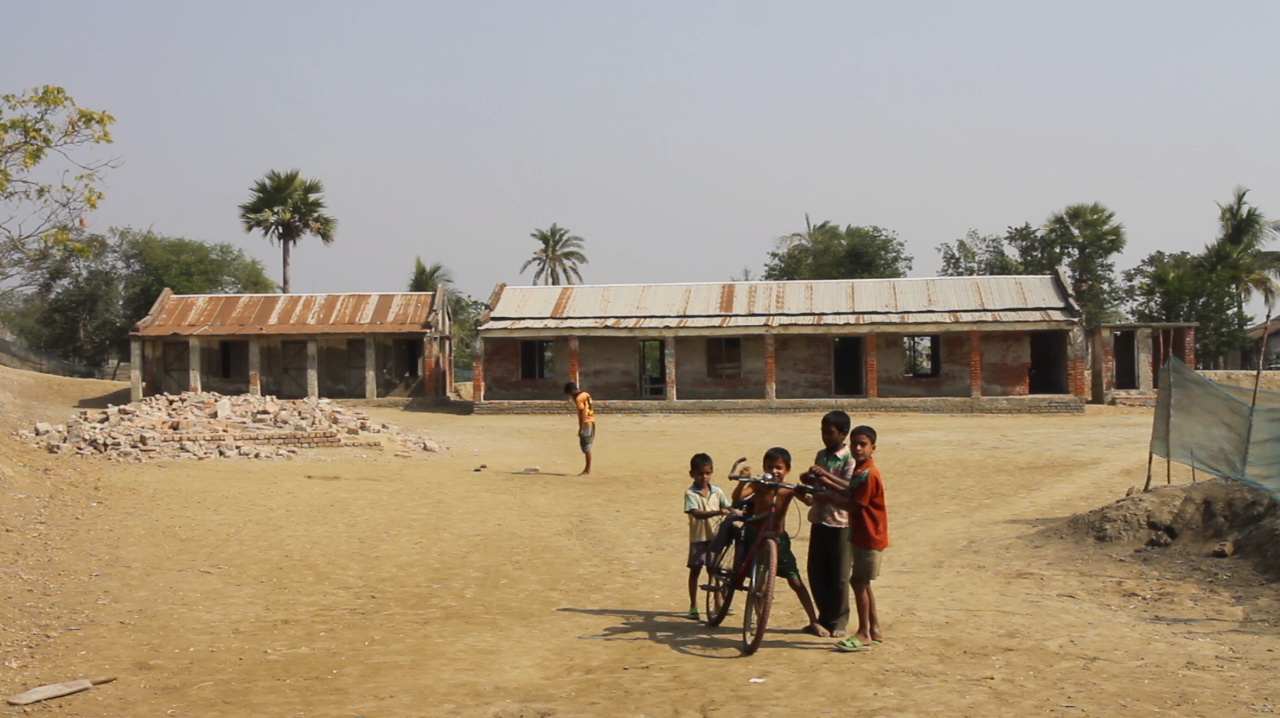
More than half of Bangladeshs population (70 % women) are analphabets. Instead of securing housing, an appropriate standard of living and investing in public community centers or more importantly in schools, the government spends money on building mosques. Satkhiras school has been closed down and been started to torn down to make space for a new mosque. Since the school is closed, residents have begun dismanteling the building, using it as building material for their private houses.
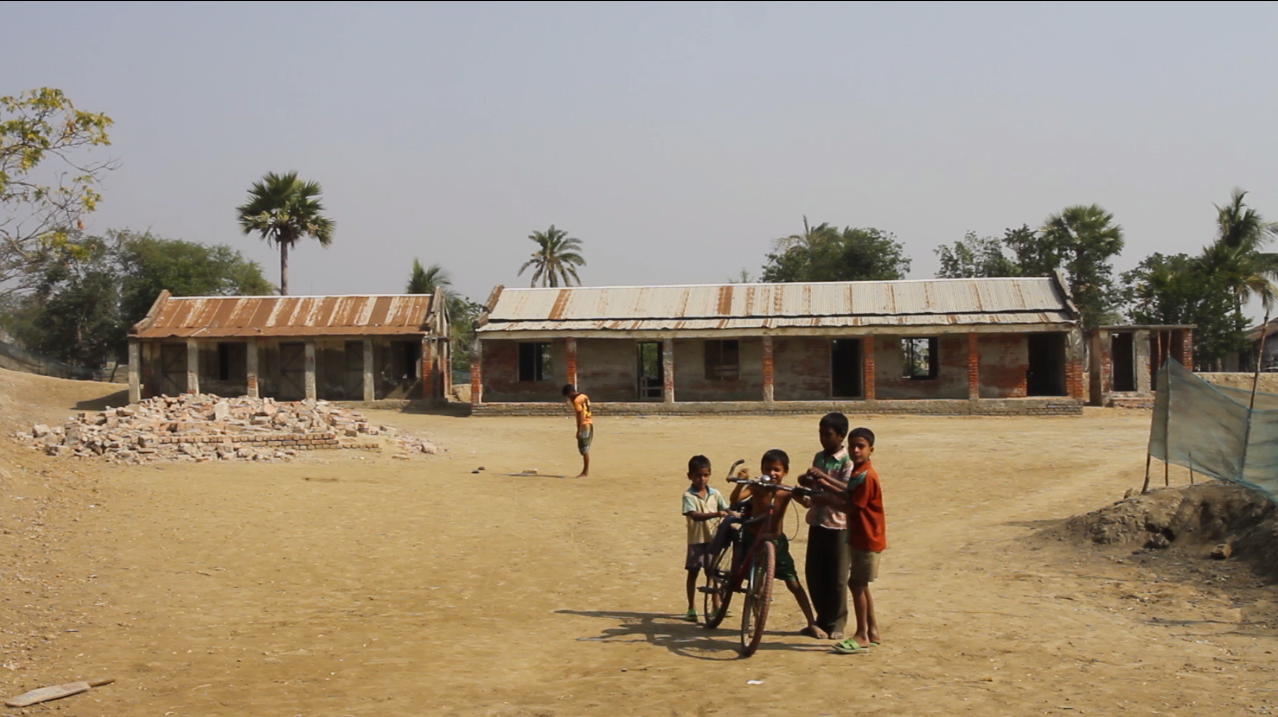
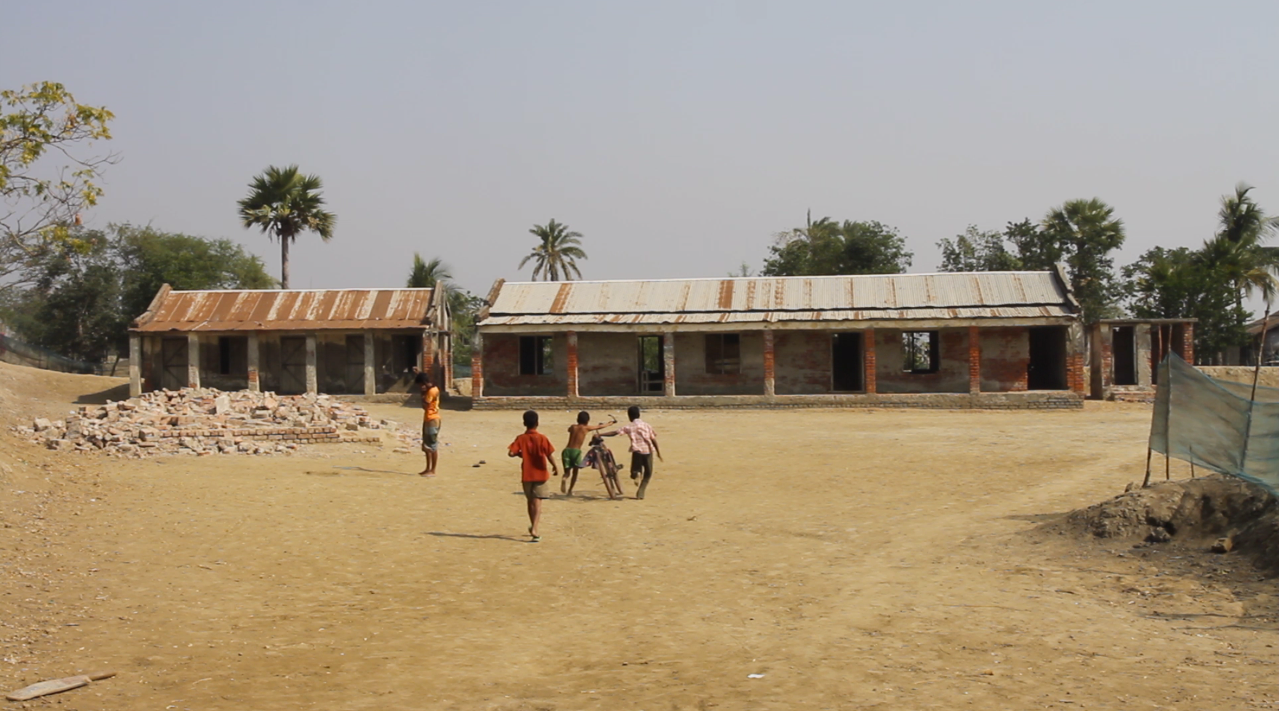
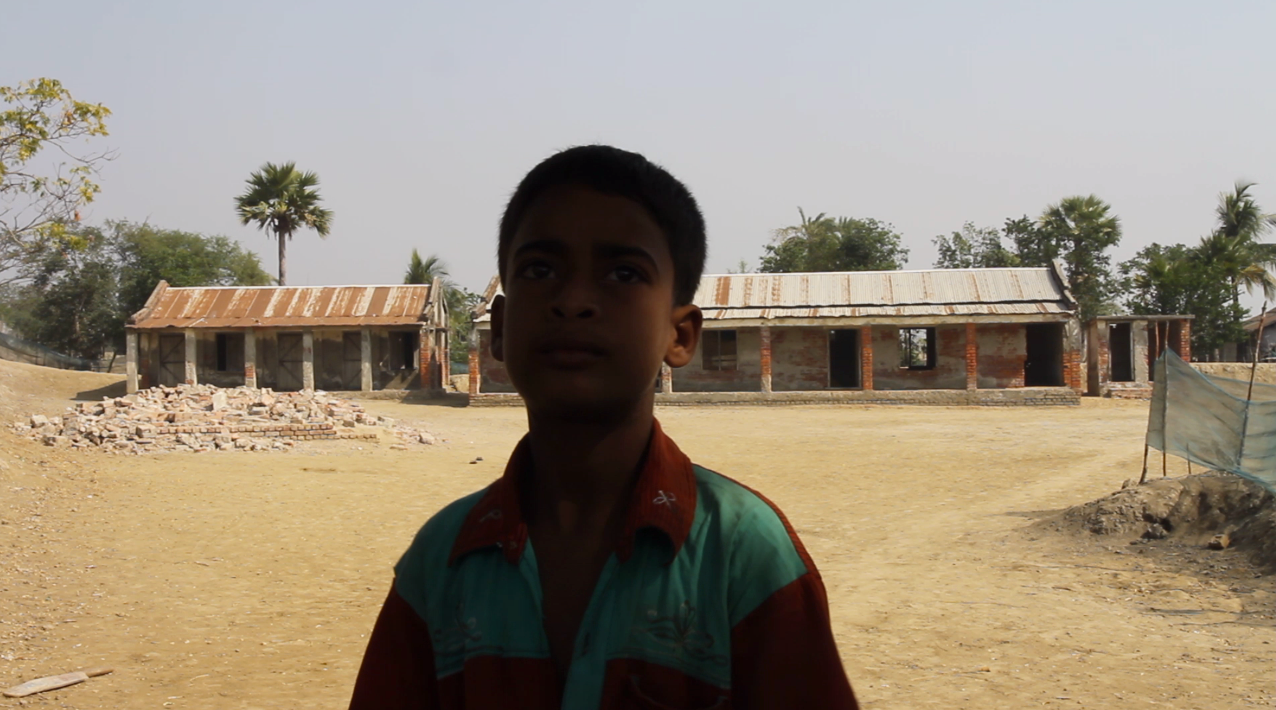
The video work shows four children playing on the former schoolyard. In their play the children are sharing a bike and are excited about being filmed. They begin to pose. Gradually, each of the children comes running behind the camera (behind the fourth wall) to view the scene from the camera‘s point of view. Each of the children presents itself to me with their name and I am asked to audition all of the various names over and over again in front of them, making the kids laugh happily.
The action moves behind the camera and remains as almost as a still image and sound document, leaving the former schoolyard empty as it is.
UTOPIA – THINKING HYPERBOLIZES ALWAYS
public intervention
room sealed entirely with duct tape
2007
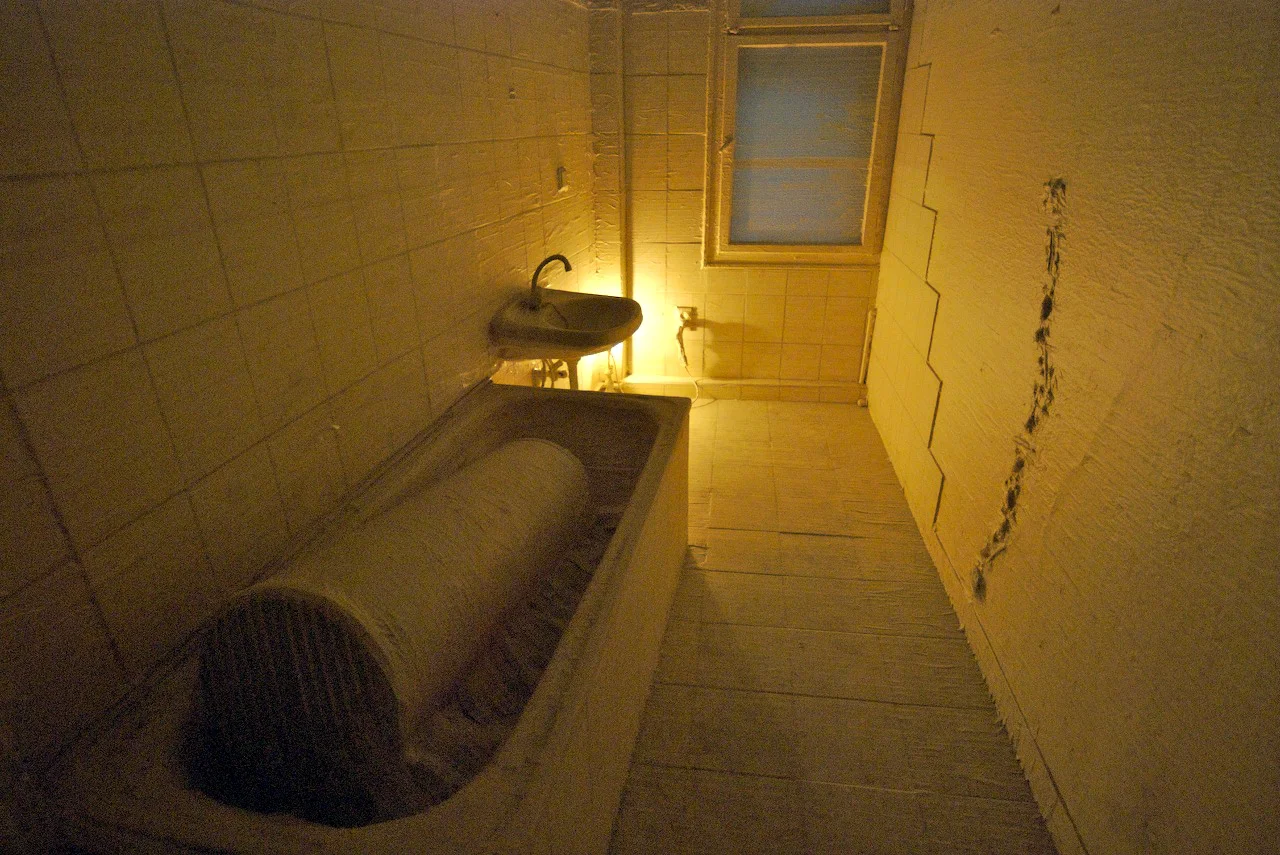
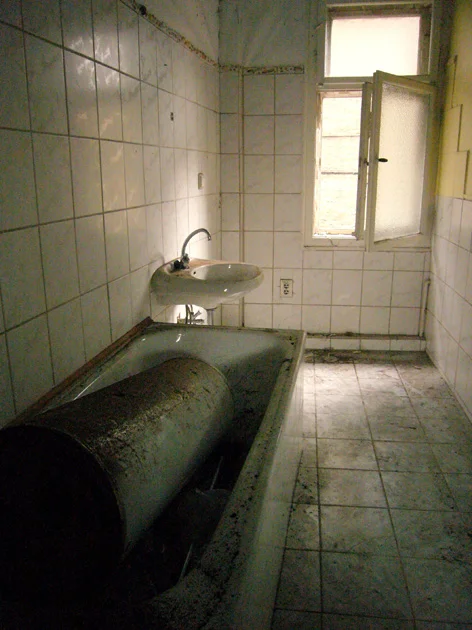
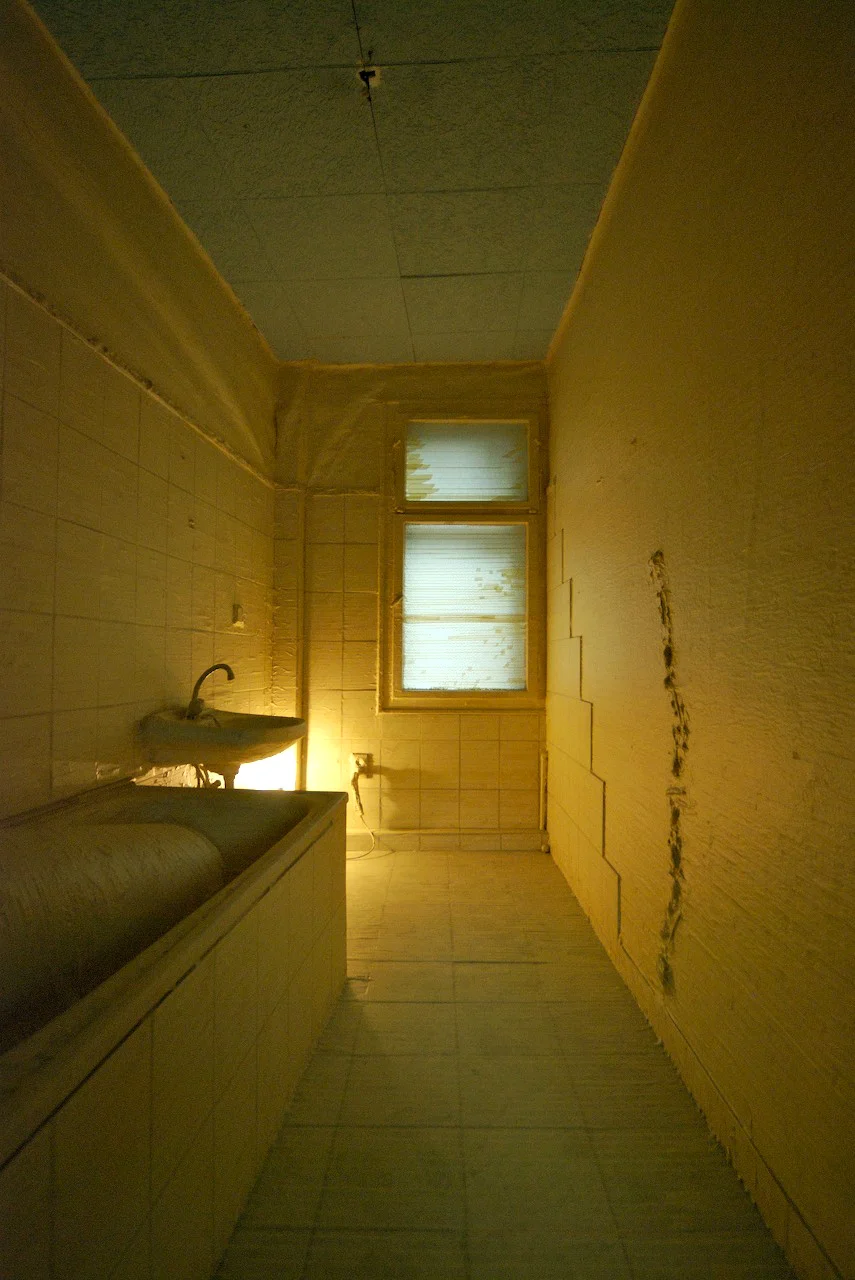
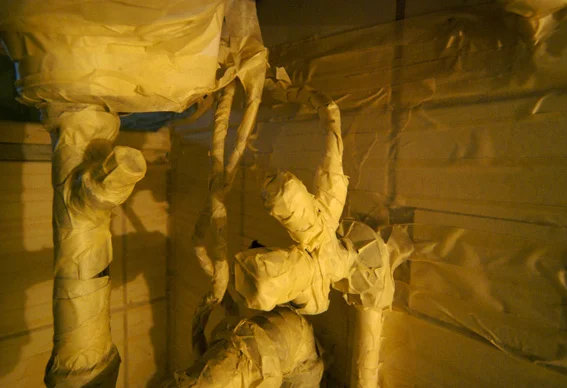
The work Utopia - Thinking hyperbolizes always deals with the life long, sotospeak infinite process of thinking, pondering thoughts, the incapability of finding, yet longing for answers and even finding the right questions that potentially can be answered.
Based on the idea, that critical thinking is what keeps us as human beings alive and that there is a certain desire to come to conclusion, a found room in an abandoned building was entirely covered with duct tape, on the floor, the walls and on the ceiling. The iterating action itself, that apparently seems to be purposeless, marks an attempt being occupied through labor, an activity not to deny cerebration, but to eventually find the right answers.
IM SINNE VON BEZUG NEHMEN – ODER WARUM ICH DICH NICHT LIEBEN KANN (In all of these worlds - or why I cannot love you)
Intervention in public space
entire material proberty of the artist in display for 4 weeks
2009
The direct revelation of private material possessions and the
question of an associated relevance to the personal existence,
examines how the objects of our daily use, may be due to
abandonment, replaceable and irrelevant to our live in the end.
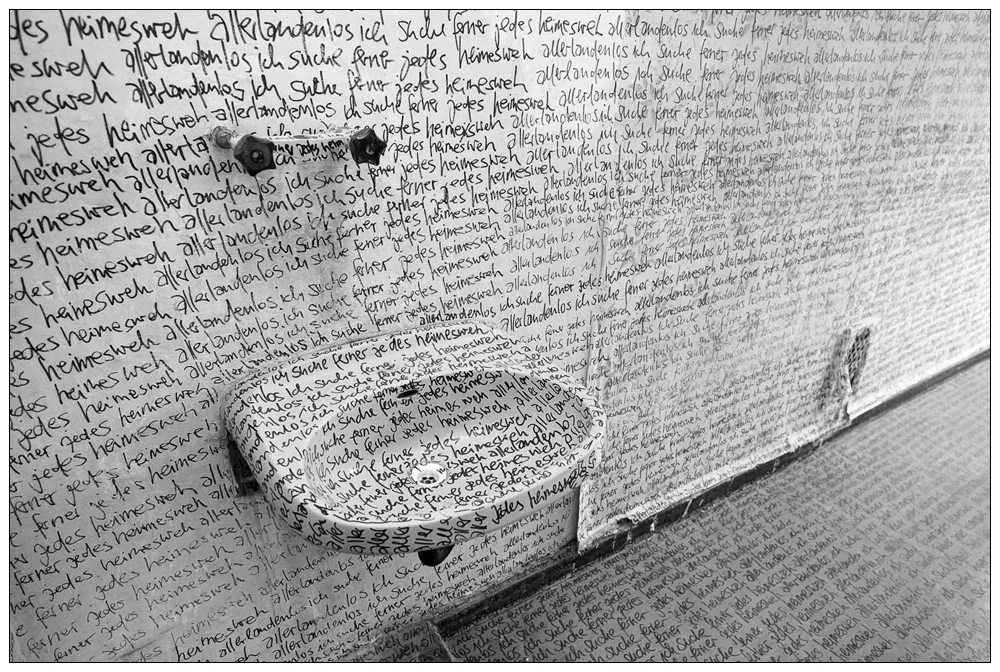
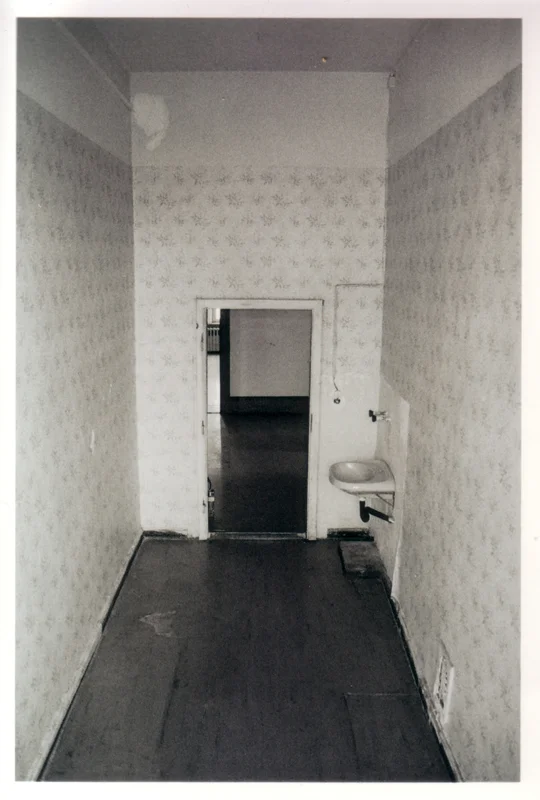
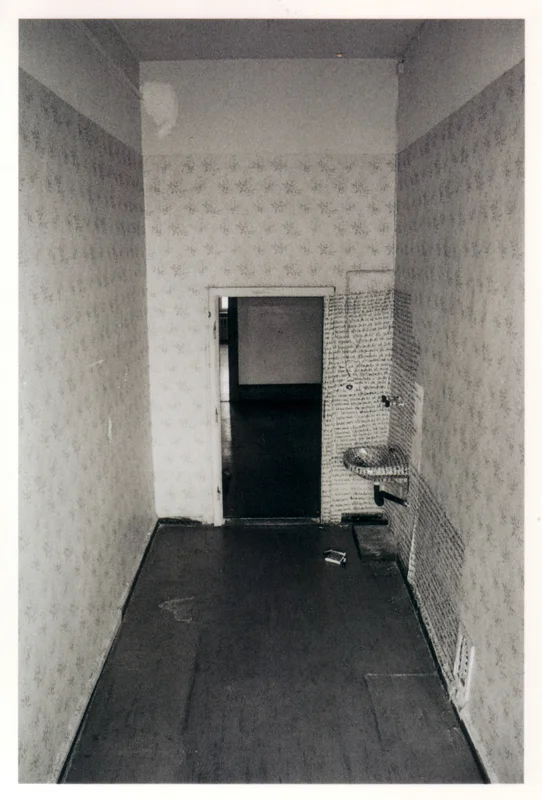
ALLERLANDENLOS – ALL LANDLESS
performance / public intervention
2005
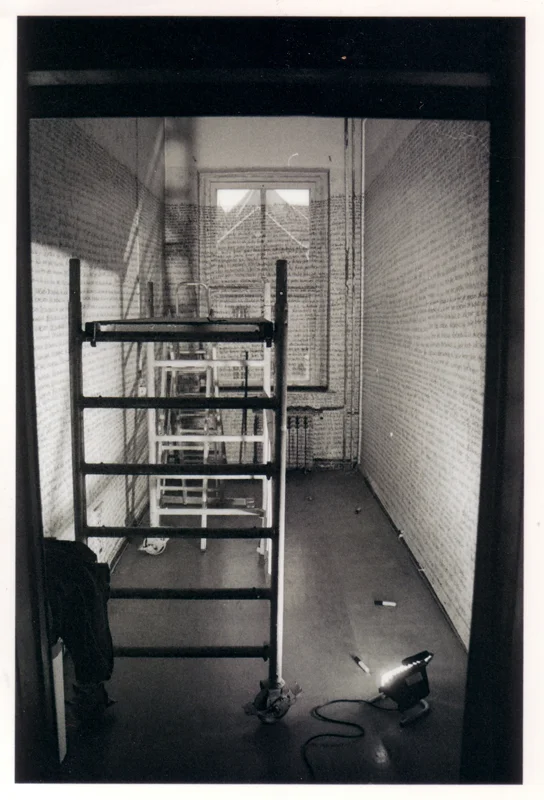
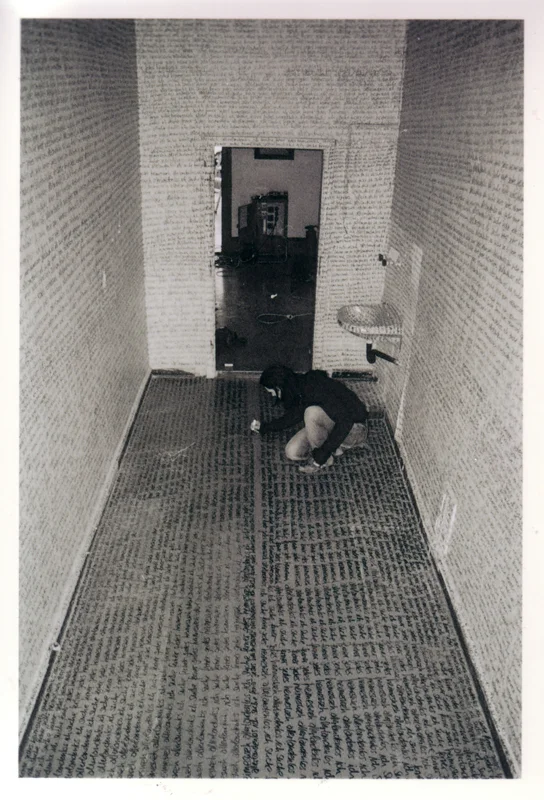
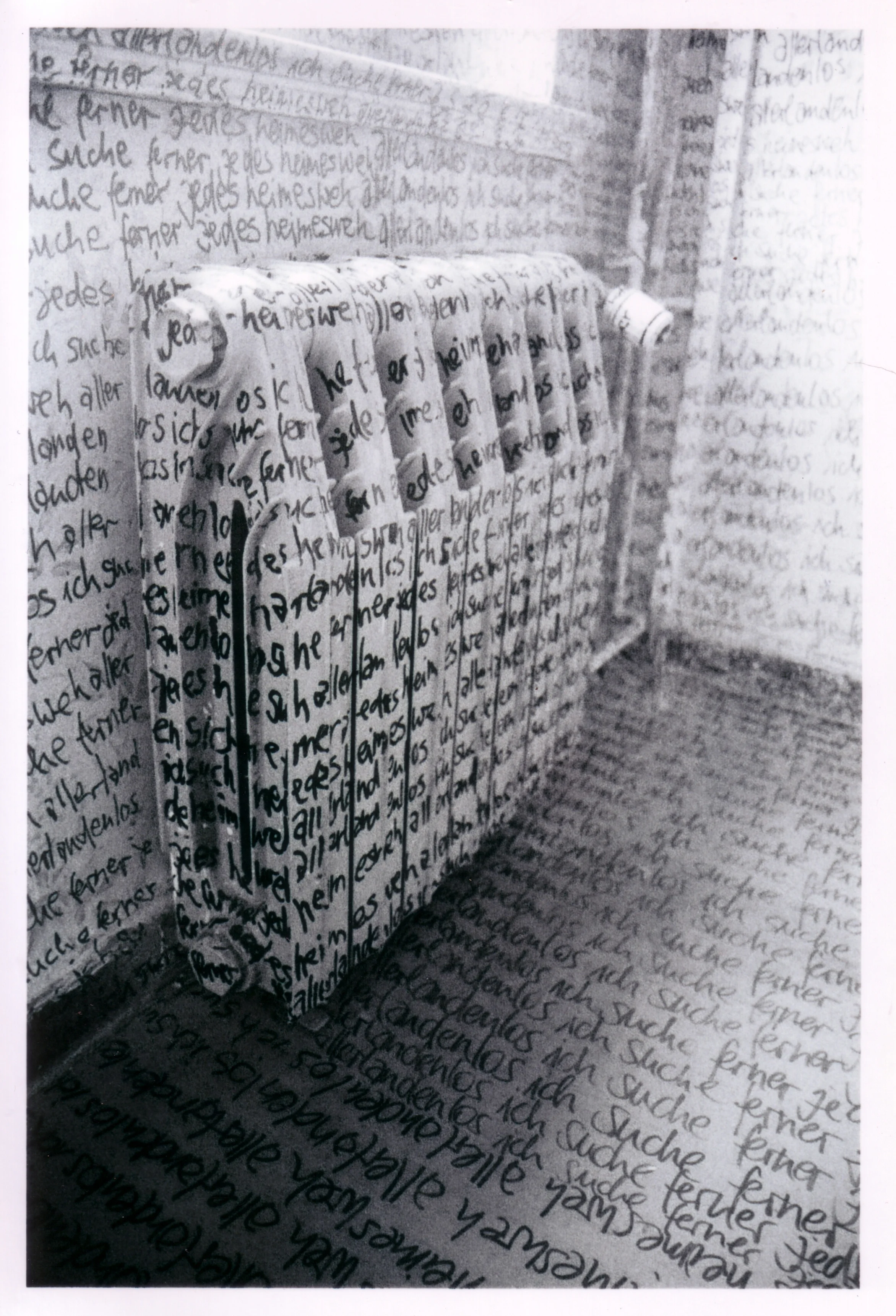
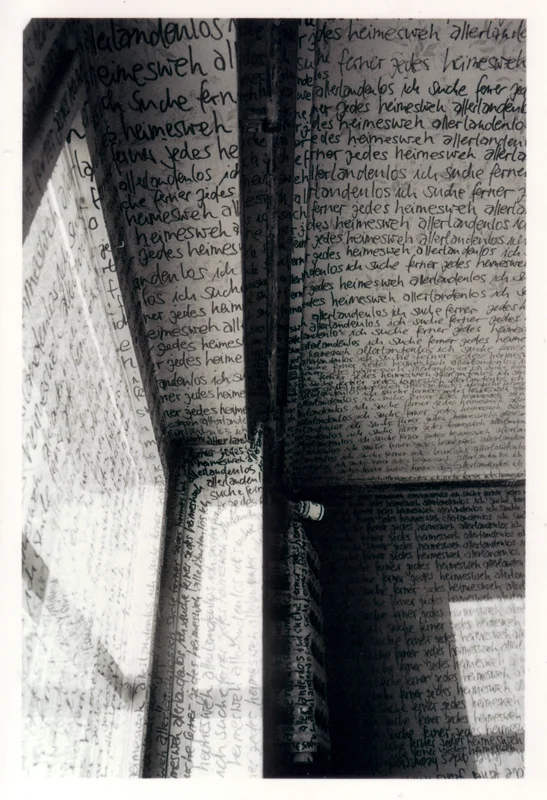
An empty room is entirely filled with only one sentence: „Allerlandenlos ich suche ferner jedes heimesweh.“ (All landless I am looking for any home.)
© 1st photo: Candy Welz
JASON INN 2012
1-channel video (12 min)
Athens
2012
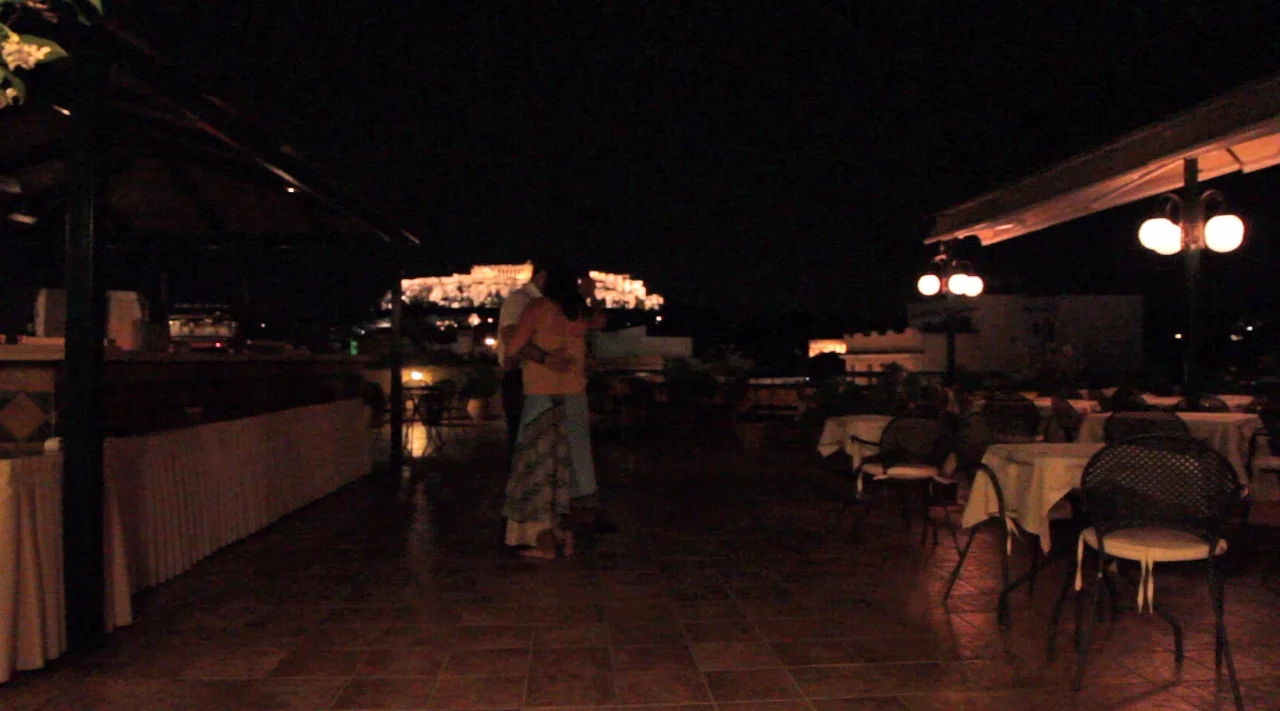
An abandoned rooftop of a hotel in the city center of Athens. The Acropolis, as a historical symbol for democracy and civilization is brightly lit and overlooks the city majestically as it has been doing so for thousands of years. It is the night of June 17, 2012 – the second election day of this year in Greece comes to an end. The country has just elected with deep resentment its parliament for the second time, after the first ballot, on May 6, 2012 had not come to a final decision.
The polling stations have been closed for several hours now, but the results are not yet announced. The most important decision for this country, that is financially and politically severely struggling has not yet fallen. The results of the election will not only be relevant to Greece and its people, but eventually demonstrate how the idea of Europe and the institution of the European Union is sadly fractured. In the meantime, heavy protests have come to the city, paralysing all public life and showing off a deep disagreement with especially Angela Merkel and Germany in generell. There is swastika symbols publicly shown on the streets and on most of the images, the german chancellor has been decorated with Hitlers’ beard.
The waiter of the hotel bar asks me for a dance before the election results are announced and the momentous vote is potentially decided, for or against Europe. We dance to traditional Greek music and commit to our love for Europe, Greeces’ membership and this wonderful summer evening of German-Greek friendship.
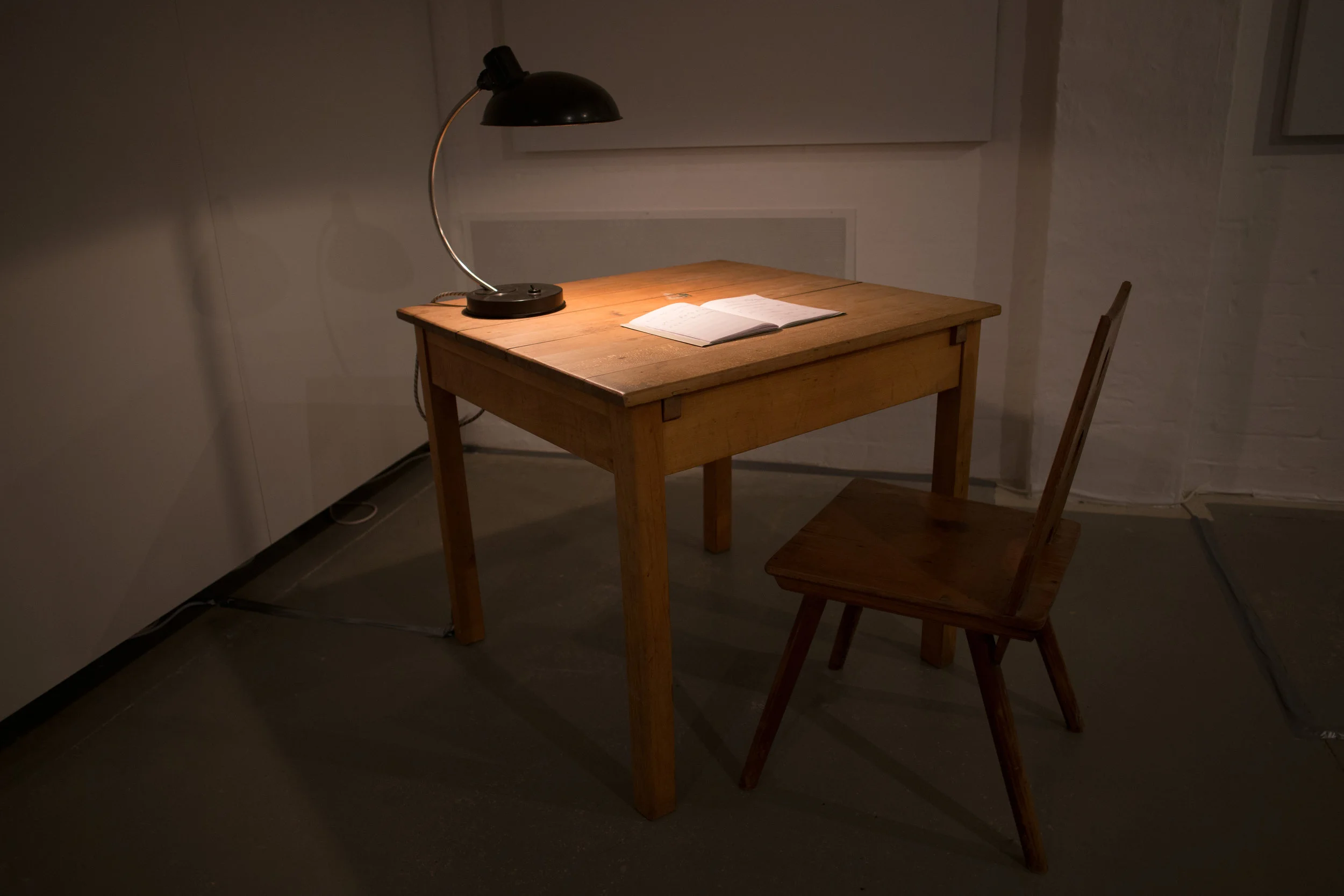
URSACHE IST’S NUR WO’S HAPERT (Cause is only where there is lack)
Installation, ready-made
typewriter with fixed keys
2007
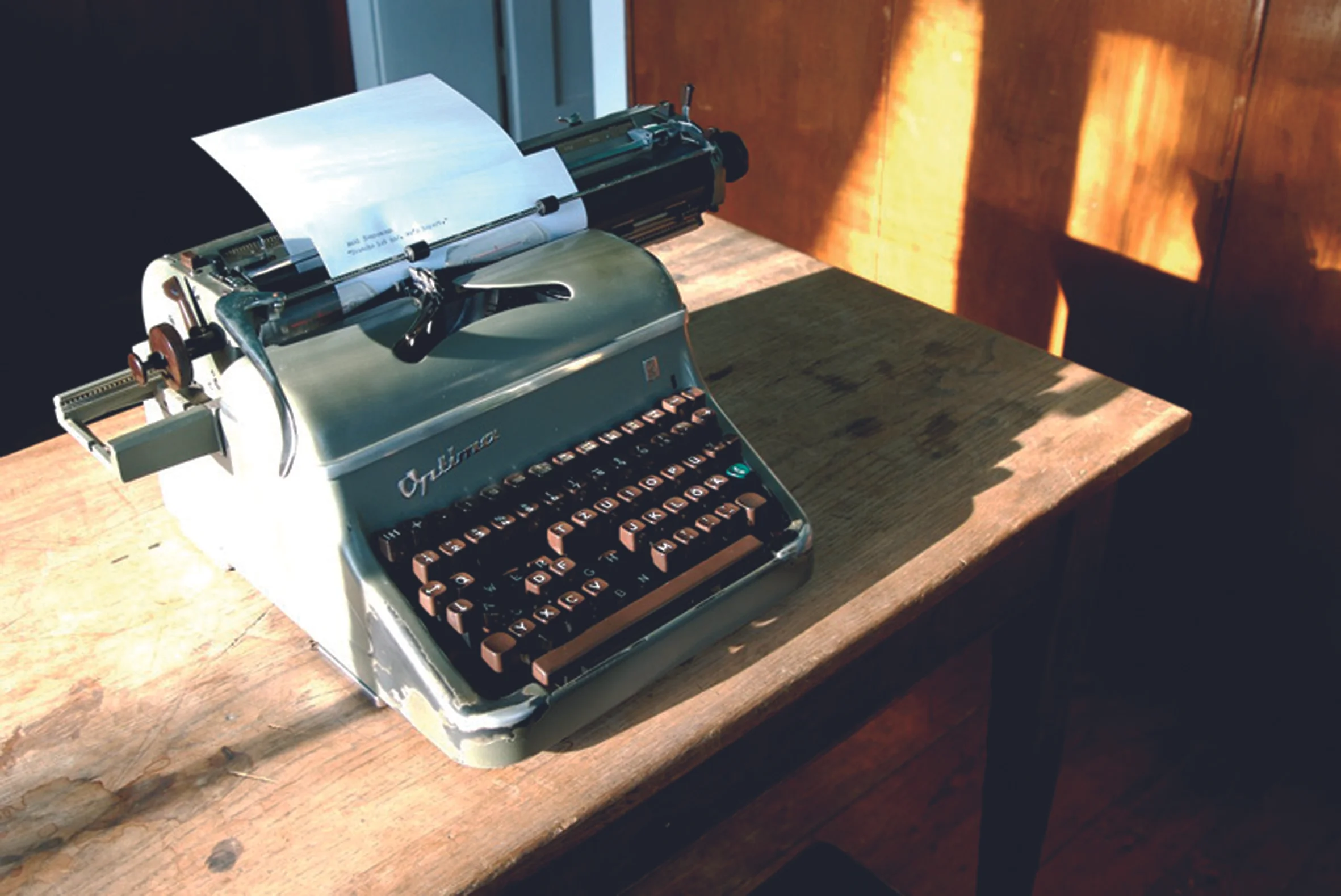
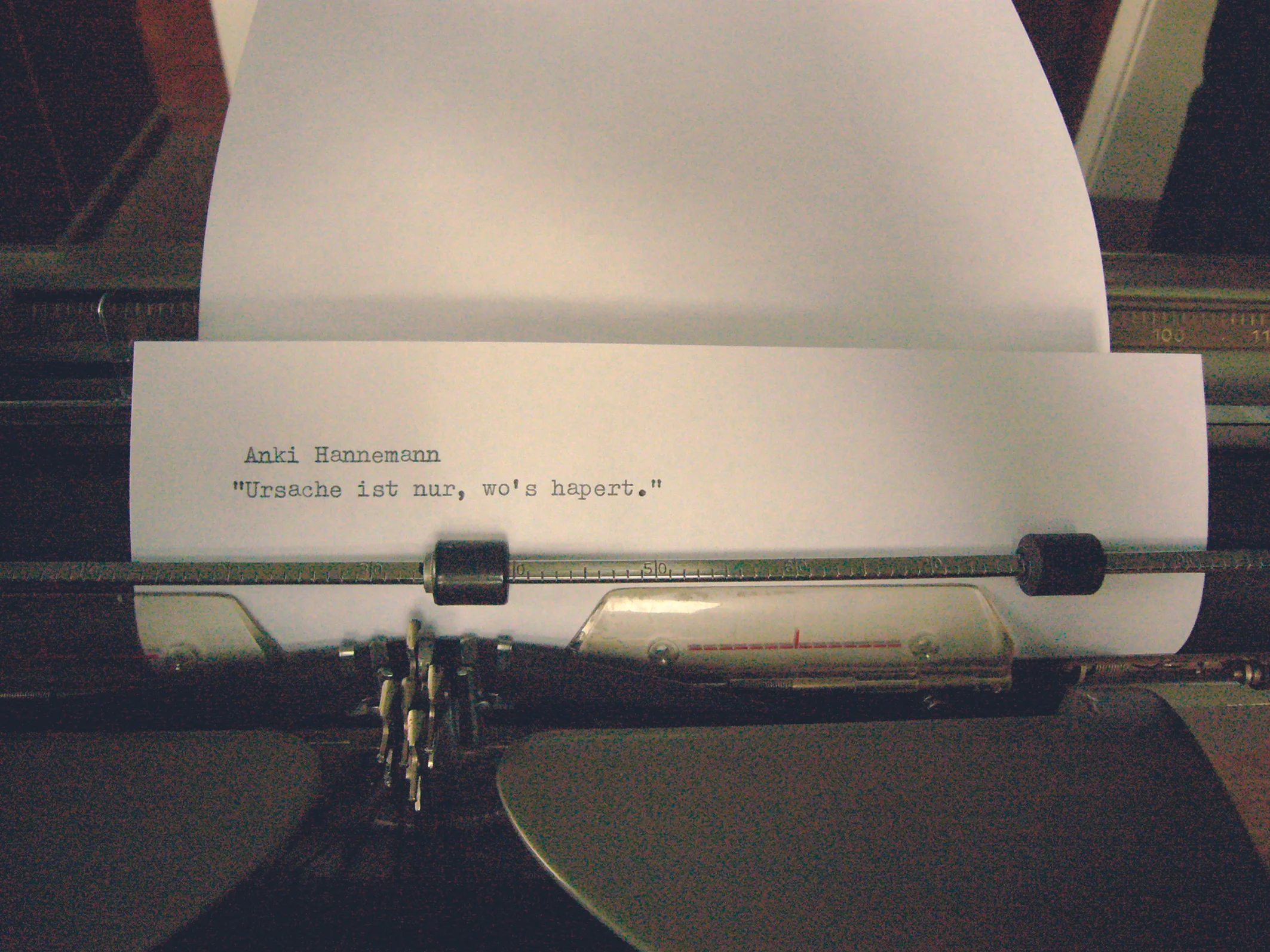
A table, a chair and a typewriter of which some of the keys are stuck, forming the word ‚Begehren‘ (‚desire‘), if one could only use the typewriter. One sentence is yet already written on the paper: „Ursache ist nur, wo‘s hapert.“ (Cause is only where there is a lack)
© photo: Georgios Wenetiadis
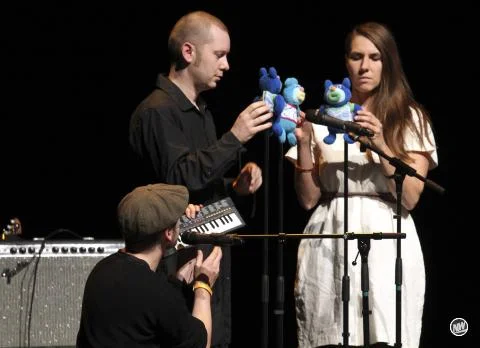
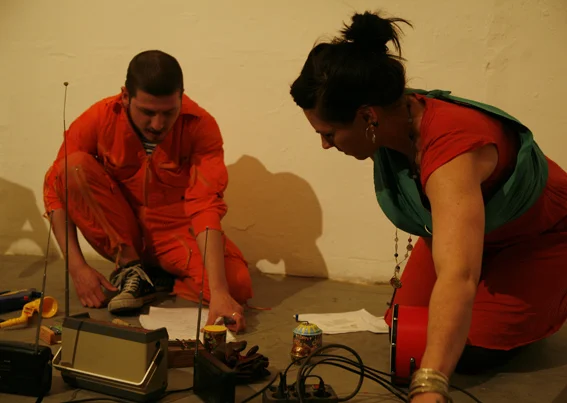
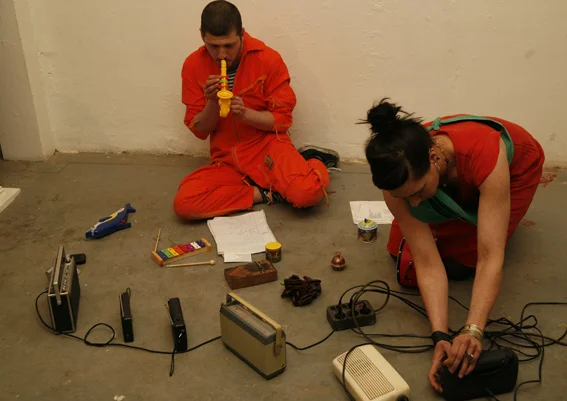
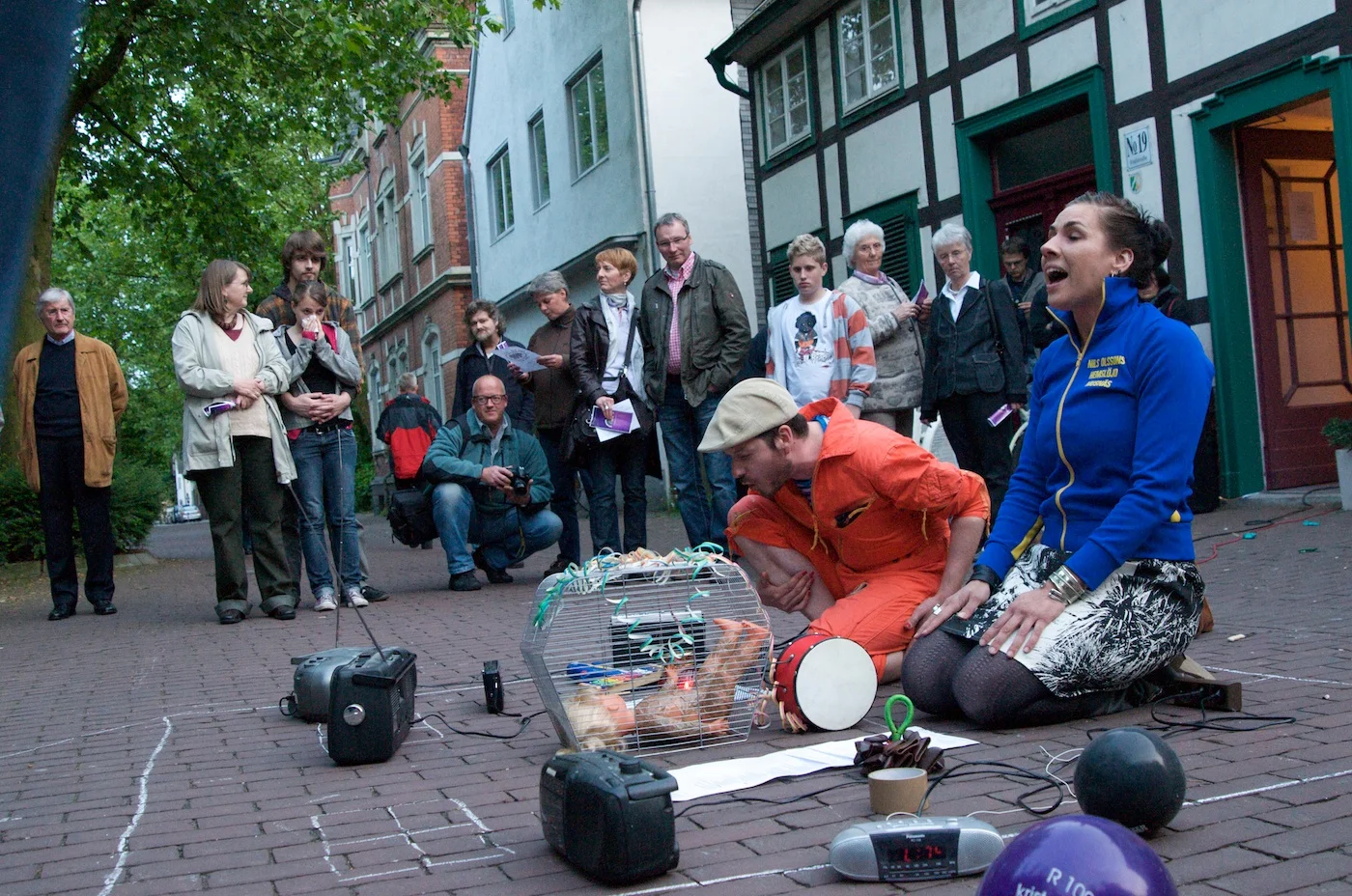
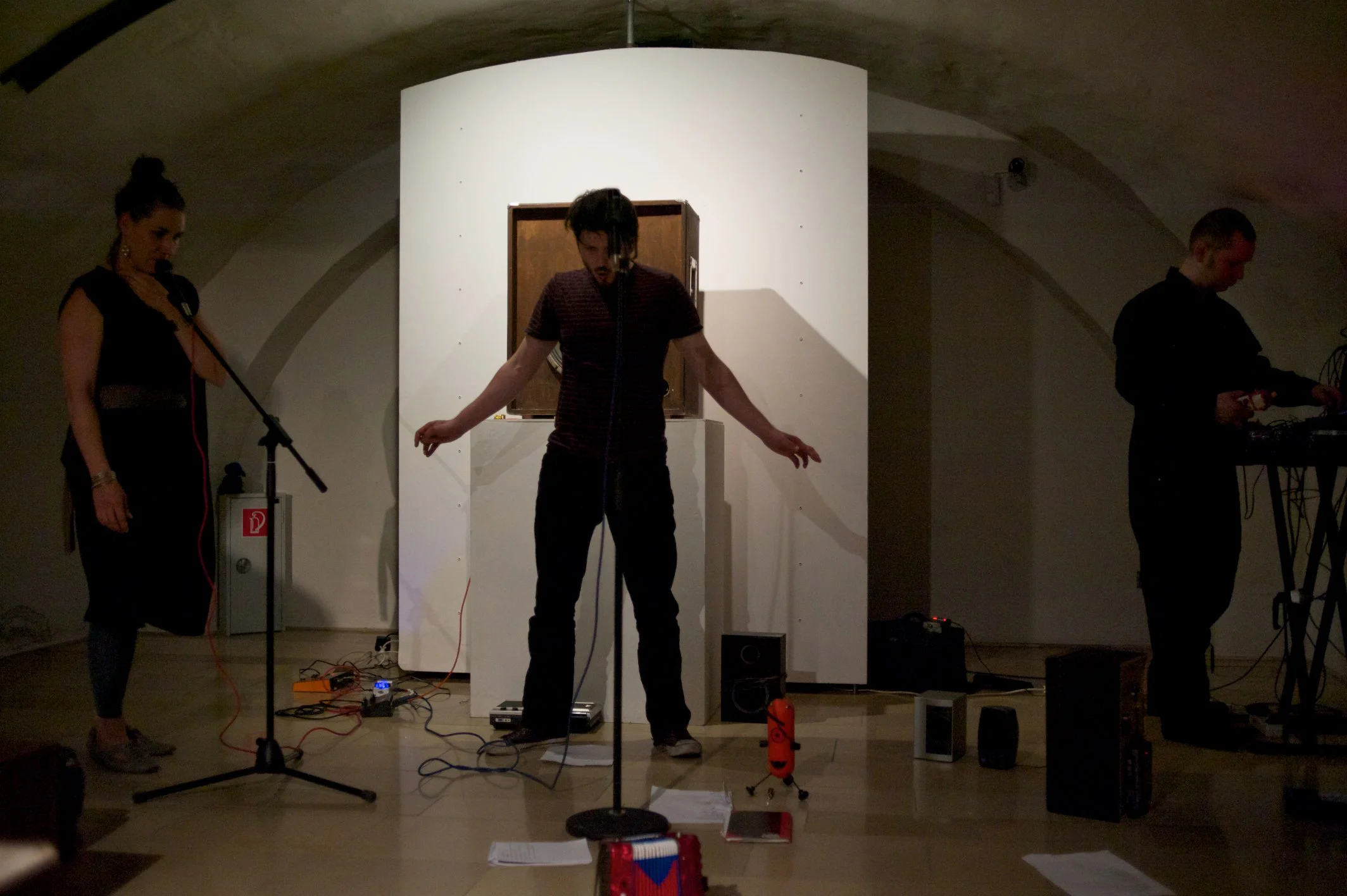
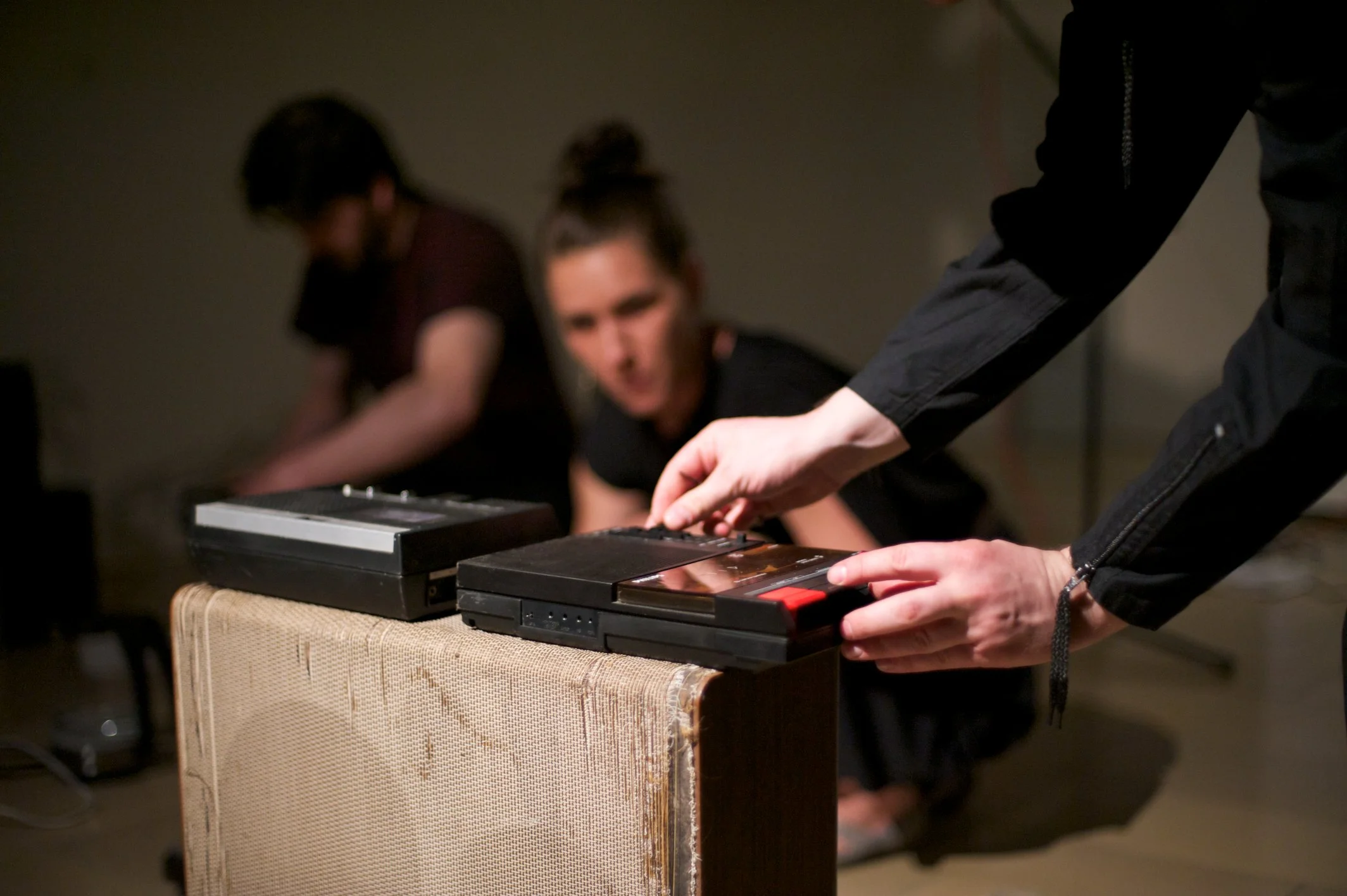
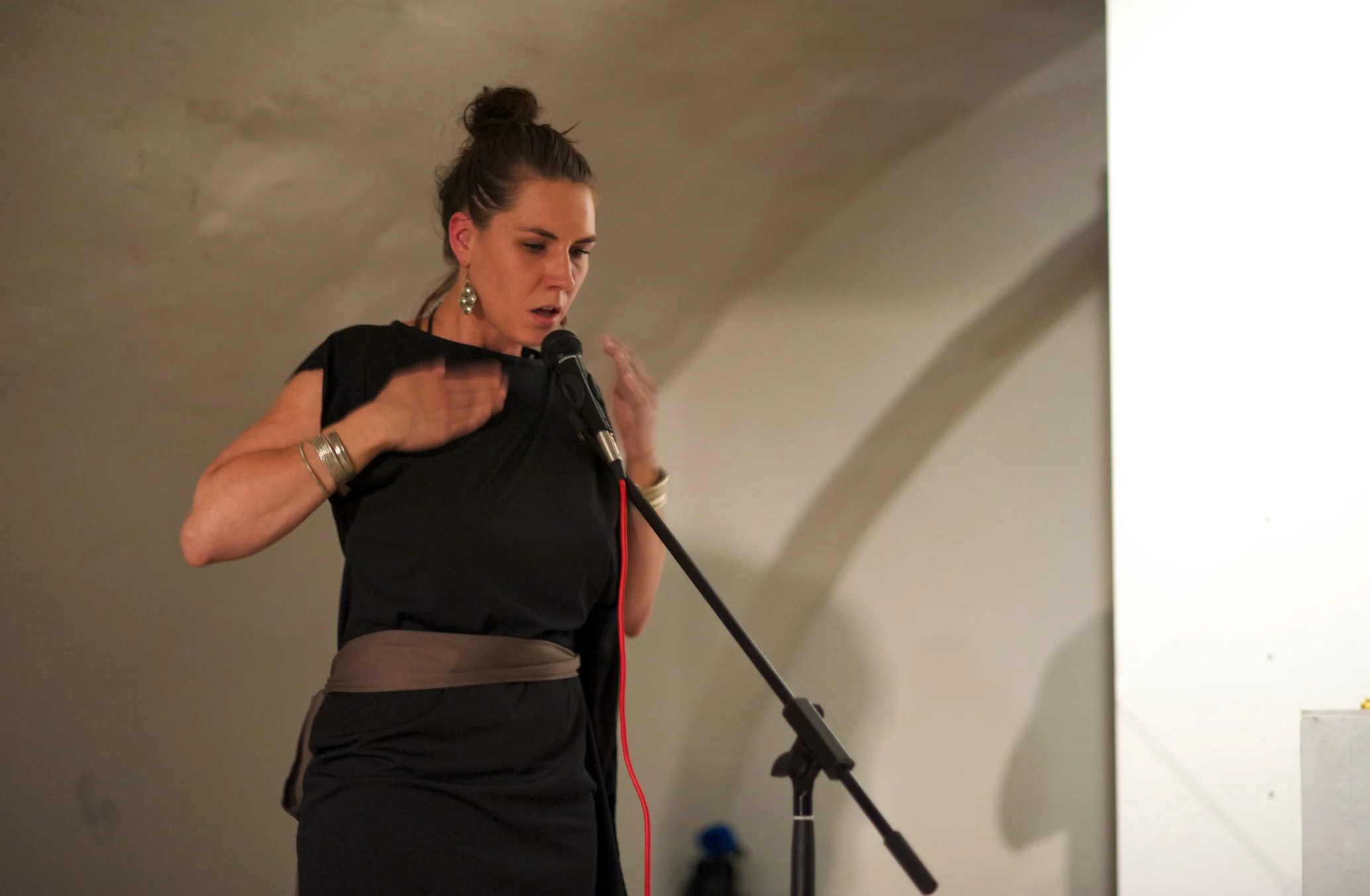
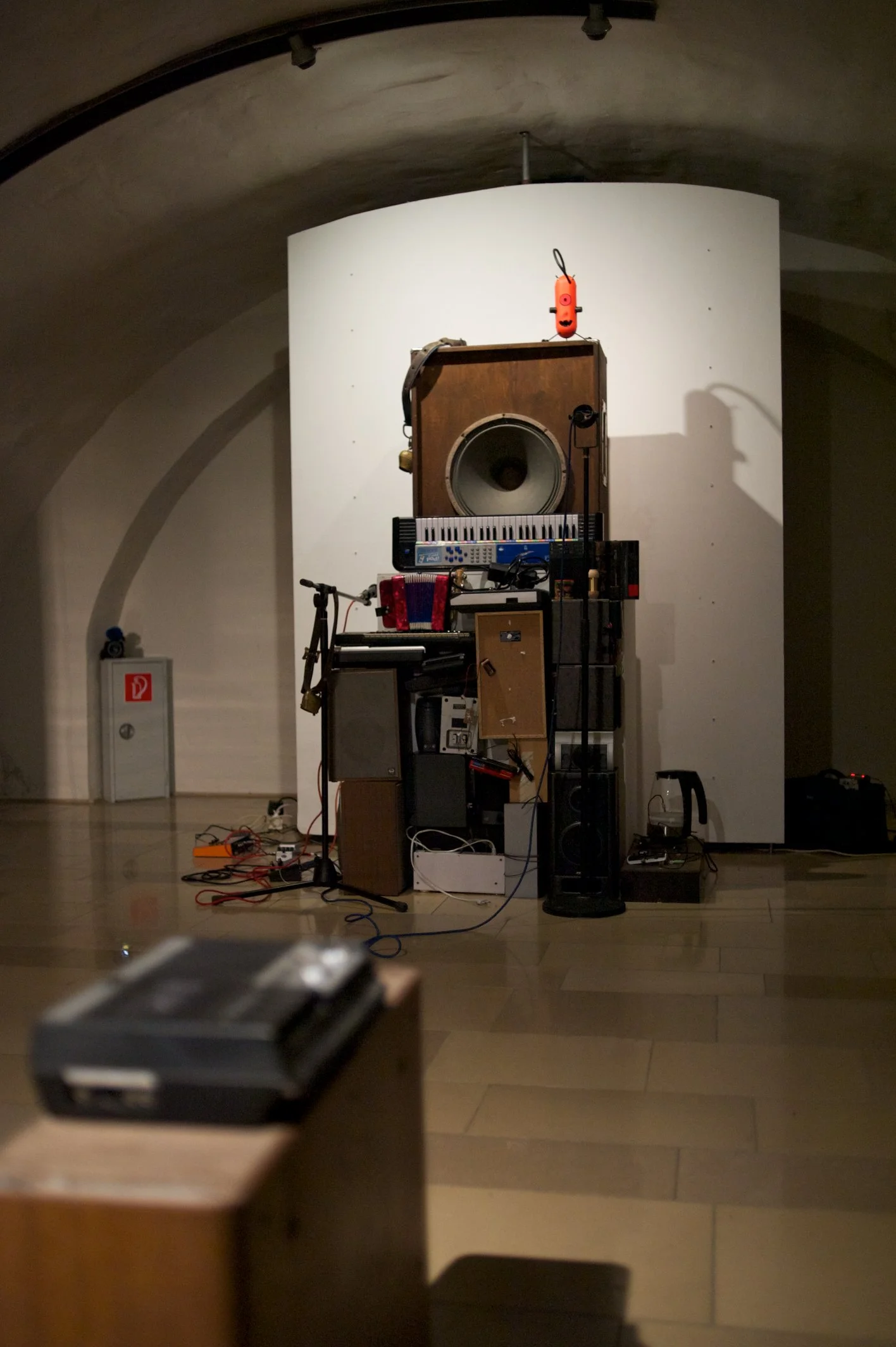
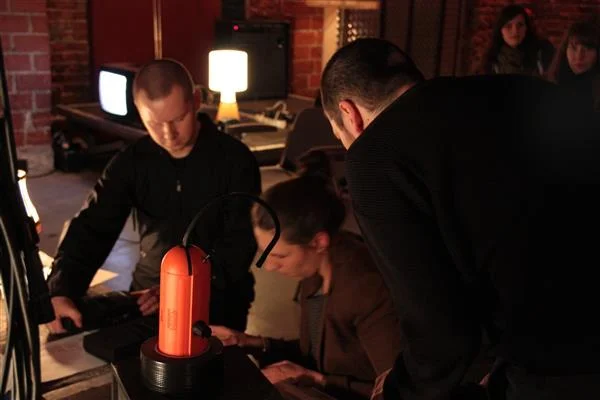
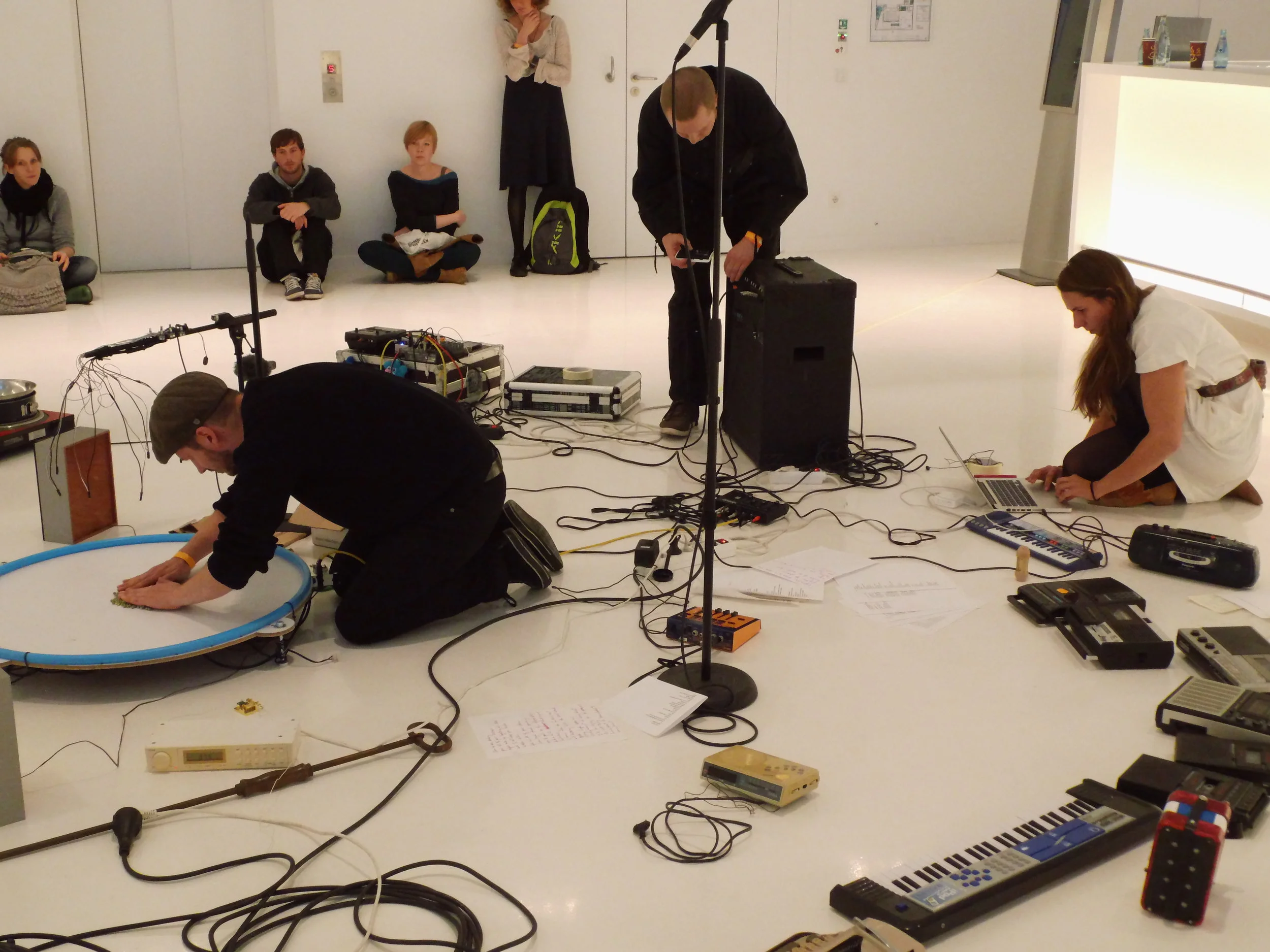
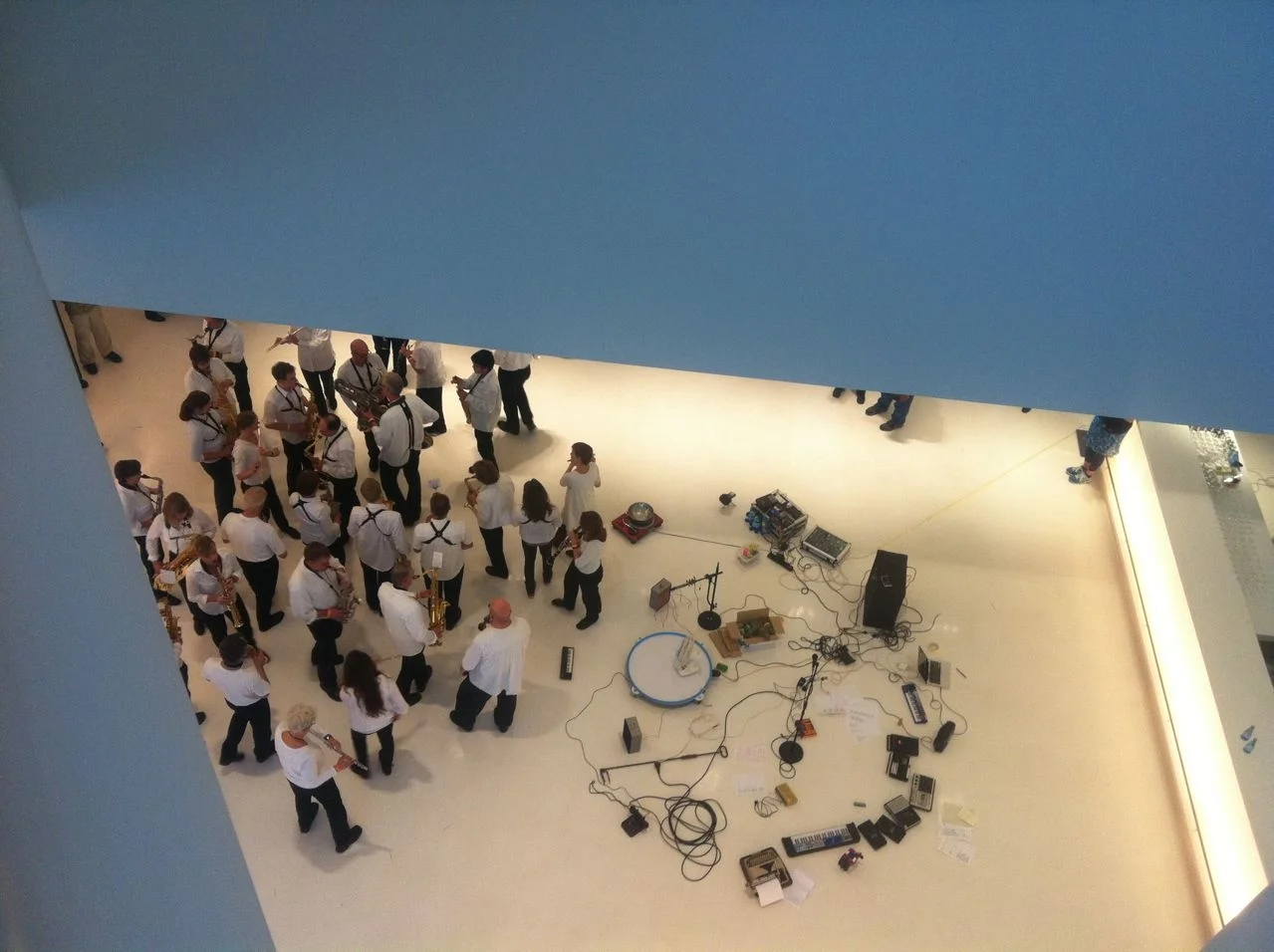
radioLIT
live-sound performance group together with Stan Pete and Patrick WEH Weiland
Die Künstlergruppe radioLit arbeitet seit 2009 zusammen und besticht durch ihren eigenwilligen Einsatz gefundener, ausrangierter und wieder zusammengesetzter Materialien: modifiziertes elektronisches Kinderspielzeug, defekte Radios, unzählige Verstärker, ein Konvolut an Lautsprechern und der lyrische Laut ferner Stimmen, erzählen von abgelegten Erinnerungen und Mundgesalzenen Rhythmikkoinzidenzen. – Eine Performance, notenbeinvernäht.